
Trusted by 1,250+ Architects, Developers & Real Estate Professionals
quick-answer-photoreal-vs-stylized

Photorealistic vs Stylized Rendering: When to Choose Each

Photorealistic vs stylized rendering comes down to the decision the image must support: photorealistic 3D exterior rendering uses physically based materials, global illumination, and calibrated camera optics to simulate a built outcome for sales, financing, and entitlement, while stylized rendering applies non-photorealistic rendering (NPR) techniques such as simplified materials, graphic lighting, and illustrative color to[…]


what-does-3d-rendering-do-zoning

How 3D Exterior Rendering Is Helping US Developers Navigate Zoning and Community Opposition

A 3D rendering zoning community opposition strategy uses physically based, context-matched exterior visualizations to translate site plans, massing, setbacks, and elevations into images that planning commissions and neighbors can read in seconds. Developers who submit verified-viewpoint renderings with shadow studies, landscape buffers, and streetscape context close the interpretation gap, which is a frequent source of[…]

exterior-rendering-lifecycle

Types of Exterior Rendering Techniques: Still, Aerial & Street-Level

The three primary types of exterior rendering techniques are still-image renders (fixed-camera photorealistic views), aerial renders (bird’s-eye or drone-style perspectives showing site context and massing), and street-level renders (eye-height, pedestrian-perspective views that simulate the real-world approach to a building). Each technique serves a distinct purpose across marketing, planning approval, and design validation, and most real[…]

us-housing-rendering-ai-interactive-preconstruction-sales

3D Exterior Rendering Trends in the US Housing Market: A Market Overview

US housing market 3D exterior rendering trends in 2026 are defined by three converging forces: AI-accelerated production pipelines, real-time interactive visualization replacing static stills, and pre-construction marketing that depends entirely on photorealistic imagery rather than physical show homes. Builders across single-family, build-to-rent, and mixed-use segments now treat exterior rendering as a core sales asset, not[…]

featured-ai-3d-exterior-rendering-reshaping-design

How AI 3D Exterior Rendering is Cutting Turnaround Time and Boosting Realism for Developers.

AI 3D exterior rendering uses machine learning models, neural denoising, and generative design tools to compress traditional rendering pipelines from days into hours while improving photorealism. Architects and developers now pair AI upscaling, real-time ray tracing, and generative material libraries with human-led art direction to produce marketing-ready visuals faster than conventional CPU or GPU rendering[…]

photorealism-presale-ready

How to Choose a 3D Exterior Rendering Company: 10 Criteria That Separate Great from Average

Knowing how to choose a 3D exterior rendering company comes down to evaluating ten measurable criteria: portfolio depth across asset types, render engine and lighting fidelity (path-traced GI, HDRI-based sky systems), turnaround SLAs, revision policy, and post-production delivery standards. A studio that scores well on all ten will consistently produce photorealistic, presale-ready visuals on schedule,[…]

modern-luxury-twilight

3D Exterior Rendering vs. Architectural Photography: A Side-by-Side ROI Analysis

When comparing 3D rendering vs architectural photography ROI, 3D exterior rendering consistently delivers a higher return for pre-construction marketing because it eliminates the sunk cost of a finished building before any imagery can be captured. Architectural photography, by contrast, only becomes viable after substantial completion, which delays revenue-generating marketing by months or even years. For[…]

3d-exterior-rendering-cost-across-stages-budgeting-realistic

How Real Estate Developers Use 3D Exterior Rendering at Every Stage of a Project

Real estate developer 3D rendering stages span the entire project lifecycle: feasibility studies, investor pitches, municipal permitting, pre-sales marketing, construction updates, and final leasing. At each phase, photorealistic exterior renders replace guesswork with a visual asset that stakeholders can evaluate, approve, and buy into before a single foundation is poured. This is no longer a[…]

6-steps-visual-workflow

3D Exterior Rendering Trends in US Residential Architecture

US residential architecture rendering trends in 2026 center on real-time visualization engines, AI-assisted workflows, and hyper-realistic material accuracy that let builders market homes before groundbreaking. Developers are moving away from static, single-angle images toward interactive, multi-scene render packages that support financing, pre-sales, and social media campaigns simultaneously. This shift means firms that fail to modernize[…]

best-rendering-engine-summary

Best Rendering Engines for Exterior Architectural Visualization: A Technical Comparison

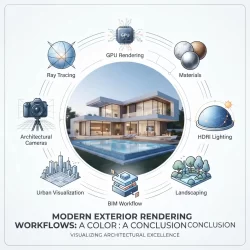
The best rendering engines for exterior visualization in 2026 are V-Ray, Corona Renderer, Lumion, Enscape, Twinmotion, and D5 Render – each optimized for different combinations of photorealism, speed, and real-time collaboration. Studios choosing between offline biased renderers and real-time GPU engines must weigh render fidelity against production turnaround, since no single engine dominates every stage[…]