
US housing market 3D exterior rendering trends in 2026 are defined by three converging forces: AI-accelerated production pipelines, real-time interactive visualization replacing static stills, and pre-construction marketing that depends entirely on photorealistic imagery rather than physical show homes. Builders across single-family, build-to-rent, and mixed-use segments now treat exterior rendering as a core sales asset, not a late-stage design deliverable. This shift is reshaping how developers budget, staff, and time their visualization work across the entire project lifecycle.


Housing starts, buyer expectations, and construction timelines rarely move in sync, but exterior rendering has become the connective layer that lets builders market a home long before ground is broken. Understanding where the technology and the market are heading matters just as much as understanding the home designs themselves.
This market overview breaks down the US housing market 3D exterior rendering trends worth tracking in 2026, drawing on hands-on production experience delivering premium 3D exterior rendering services for residential, commercial, and mixed-use projects across builder segments nationwide.
Why 3D Exterior Rendering Has Become Central to US Housing Market Strategy

Exterior rendering used to sit downstream of design, used mainly for permit submissions or investor decks. That role has expanded dramatically.
- Pre-sales now happen before framing starts. Builders routinely list homes and secure deposits using renderings alone, particularly in build-to-rent and planned communities.
- Digital-first buyers expect visual proof early. Home shoppers browsing listings online compare photorealistic exteriors the same way they compare finished listing photos.
- Design iteration has moved from physical models to visualization software. Changing a roofline or facade material takes hours in rendering software versus weeks with a physical model.
Data from the U.S. Census Bureau’s New Residential Construction reports shows housing starts fluctuate with financing conditions, which pushes builders to compress marketing timelines wherever possible – and rendering is the tool that makes that compression possible.
Key US Housing Market 3D Exterior Rendering Trends for 2026
Trend 1: AI-Accelerated Rendering Workflows

Artificial intelligence has moved from an experimental add-on to a core part of production pipelines. AI tools now assist with lighting studies, material variations, and rapid concept iterations that previously required a full render pass. Our breakdown of how AI in 3D exterior rendering is reshaping design covers this shift in technical depth, but the market-level effect is straightforward: turnaround times have compressed while output volume per project has increased.
Trend 2: Real-Time and Interactive Visualization Overtaking Static Stills

Static hero renders remain essential, but real-time engines now let buyers explore a home’s exterior interactively – rotating the view, changing time-of-day lighting, or comparing facade options on the spot. This trend is particularly strong in higher-price mixed-use and luxury single-family segments, where buyers expect a more immersive presale experience.
Trend 3: Purpose-Built Rental Communities Driving Rendering Volume

Build-to-rent has grown into one of the most rendering-intensive housing segments, since entire communities are marketed and leased before a single unit is move-in ready. Our guide on 3D exterior rendering for purpose-built rental communities outlines how these projects structure rendering deliverables around leasing timelines rather than traditional sales milestones.
Trend 4: Pre-Sales Campaigns Built Entirely Around Renderings

Developers increasingly launch full marketing campaigns – landing pages, brochures, social ads – built around a rendering package delivered months before construction completion. This approach is explored further in how 3D exterior renderings are used in real estate pre-sales campaigns, where visualization directly drives deposit conversion rates.
Trend 5: Rendering Increasingly Outperforms Traditional Photography for Early-Stage Marketing

For projects still under construction, rendering isn’t a substitute for photography – it’s the only visual option available. Our ROI analysis comparing 3D exterior rendering to architectural photography shows why builders increasingly favor rendering even once photography becomes possible, largely due to lighting control and the ability to showcase design intent without weather or landscaping limitations.
US Housing Segments and Their Rendering Priorities
| Housing Segment | Primary Rendering Use Case | Typical Delivery Stage |
|---|---|---|
| Single-family production builders | Model home marketing, floor plan variation visuals | Pre-construction through sales launch |
| Purpose-built rental communities | Leasing campaigns, amenity visualization | Pre-leasing, 6-12 months before completion |
| Mixed-use developments | Investor decks, retail/residential integration visuals | Concept design through pre-sales |
| Luxury custom homes | High-detail material studies, lighting and landscaping realism | Design development through final approval |
For builders specifically working in the production home space, our resource on 3D exterior rendering for single-family home builders maps rendering needs directly to typical production build schedules.
Traditional Rendering vs AI-Assisted Rendering vs Architectural Photography
| Factor | Traditional Rendering | AI-Assisted Rendering | Architectural Photography |
|---|---|---|---|
| Availability before construction | Yes | Yes | No – requires a finished structure |
| Typical turnaround | Days to weeks | Hours to days | Days (post-construction only) |
| Design flexibility | High – fully editable | Very high – rapid iteration | None – fixed to built reality |
| Lighting and weather control | Full control | Full control | Dependent on conditions |
| Best use case | Detailed final marketing assets | Rapid concept and iteration cycles | Post-completion listing and PR |
Step-by-Step: How Developers Are Integrating Rendering into Housing Projects
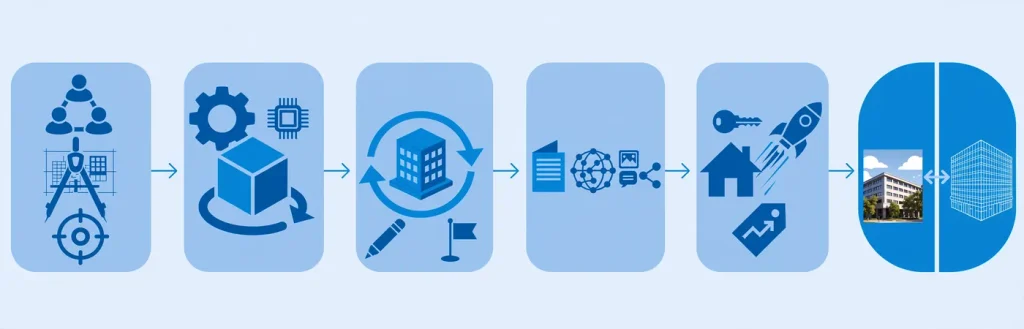
- Concept alignment. Architects and marketing teams agree on the visual direction before rendering begins, referencing early design documents.
- Software and engine selection. Teams choose rendering tools suited to the project’s realism and turnaround needs; our comparison of the best rendering engines for exterior architectural visualization is a useful reference at this stage.
- Draft rendering and feedback rounds. Initial renders go through structured revision cycles tied to design milestones, not open-ended requests.
- Marketing asset production. Approved renders are adapted into brochures, web assets, and social formats.
- Pre-sales or pre-leasing launch. Rendering assets go live alongside sales or leasing campaigns.
- Post-completion comparison. Some developers commission matching photography once construction finishes, comparing final delivery against the original rendering package.
Developers wanting a full breakdown of this sequence can review the stages developers move through when commissioning 3D exterior rendering for a stage-by-stage planning reference.
Common Mistakes Builders Make with Housing Market Exterior Rendering Strategy

- Treating rendering as a one-time deliverable rather than a campaign asset. A single hero image rarely covers pre-sales, social, and print needs simultaneously.
- Underestimating revision timelines during peak selling seasons. Rendering studios face seasonal demand spikes tied to spring and fall listing cycles.
- Skipping realistic landscaping and lighting context. Renders that look artificially staged reduce buyer trust rather than build it.
- Ignoring budget planning early in the project. Reviewing a complete 3D exterior rendering cost and price guide before scoping a project prevents mid-project budget surprises.
- Not aligning rendering scope with the actual construction timeline. Delivering final renders too early or too late relative to sales launch weakens marketing impact.
Expert Tips for Navigating US Housing Market Exterior Rendering Trends

- Budget for iteration, not just final delivery. The best-performing marketing renders usually go through multiple design refinement rounds.
- Match rendering realism to price point. Ultra-high-detail renders matter more in luxury segments; production home builders often benefit more from speed and volume.
- Coordinate rendering timelines with sales and leasing launches from day one. Treat rendering as a marketing dependency, not a design afterthought.
- Reuse rendering assets across formats. A single well-planned render package can support web, print, and social without re-commissioning new assets.
- Stay current on rendering engine capabilities. Engine improvements move quickly enough that a workflow built two years ago may already be outdated.
Where the US Housing Exterior Rendering Market Is Headed

Housing production activity, tracked through resources like the Census Bureau’s residential construction data and industry research from the National Association of Home Builders, continues to show demand for faster, more flexible marketing tools as construction costs and timelines remain under pressure. Broader housing research from the Joint Center for Housing Studies at Harvard University similarly points to sustained demand across build-to-rent and multifamily segments – both of which lean heavily on rendering for pre-completion marketing.
As AI tools mature further, expect rendering turnaround times to keep compressing while realism keeps improving, making high-quality visualization accessible to a wider range of project sizes rather than only large-scale developments.
FAQ
What is driving the growth of 3D exterior rendering in the US housing market?
Growth is driven mainly by pre-construction marketing needs, AI-accelerated production workflows, and buyer expectations for photorealistic visuals before a home is physically built.
Is AI replacing traditional 3D exterior rendering artists?
No – AI tools are accelerating specific parts of the workflow, such as iteration and lighting studies, while skilled rendering artists still handle creative direction, accuracy, and final quality control.
Which US housing segment relies most heavily on 3D rendering?
Purpose-built rental communities and large-scale mixed-use developments tend to rely most heavily on rendering, since entire projects are marketed and leased before construction completes.
How far in advance of construction should rendering be commissioned?
Most builders commission initial rendering packages six to twelve months before sales or leasing launch, allowing time for revisions and marketing asset production.
Can 3D rendering fully replace architectural photography for housing marketing?
Not entirely – rendering is essential before construction completion, but many builders still commission photography once a project is finished for authenticity in later marketing and press coverage.
Conclusion

The US housing market 3D Exterior rendering trends shaping 2026 all point in the same direction: rendering is no longer a late-stage design formality but a core marketing infrastructure that builders depend on from concept through completion. AI-assisted workflows, real-time visualization, and rendering-driven pre-sales campaigns are becoming standard practice across single-family, rental, and mixed-use segments alike.
If your project needs rendering aligned to your sales or leasing timeline, get expert 3D exterior rendering support for your next housing development and build your marketing campaign around visuals that perform from day one.