
US residential architecture rendering trends in 2026 center on real-time visualization engines, AI-assisted workflows, and hyper-realistic material accuracy that let builders market homes before groundbreaking. Developers are moving away from static, single-angle images toward interactive, multi-scene render packages that support financing, pre-sales, and social media campaigns simultaneously. This shift means firms that fail to modernize their visualization pipeline risk losing buyers to competitors who can show a finished home months before it exists.
Homebuilders, architects, and multifamily developers across the country are rethinking how they present unbuilt projects. Instead of relying on hand-drawn elevations or blueprints that only a trained eye can interpret, they are turning to premium 3D exterior rendering services that turn a floor plan into a photorealistic, marketable asset. This article breaks down the trends driving that shift, the mistakes to avoid, and how to choose a rendering partner that keeps pace with where the industry is headed.
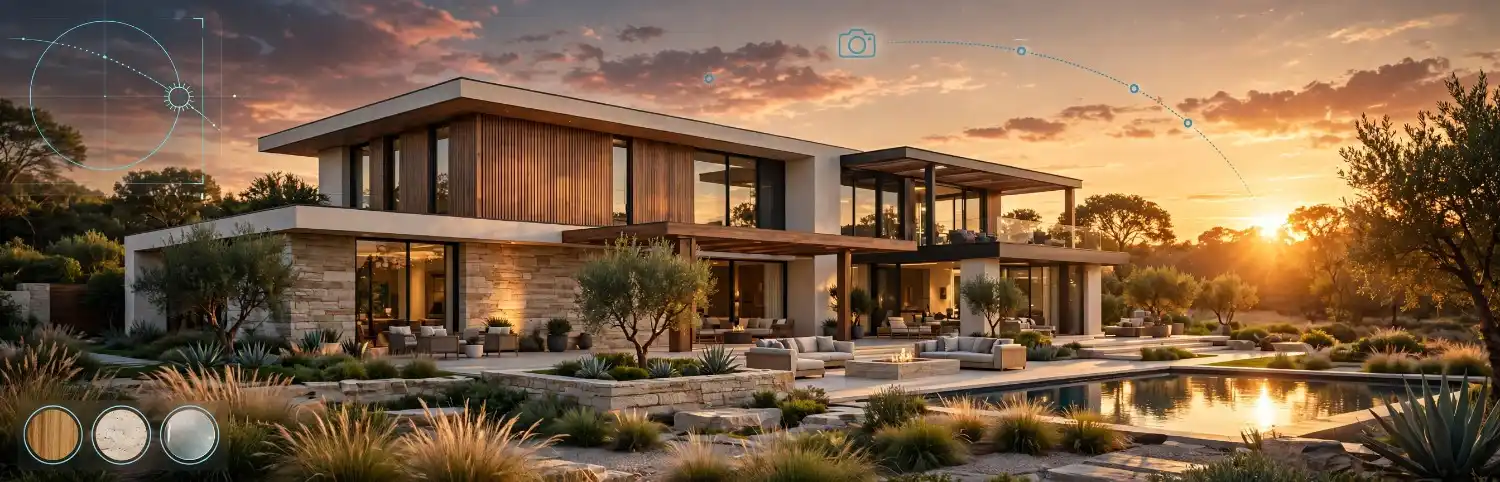
What is Driving US Residential Architecture Rendering Trends in 2026
Three forces are reshaping the rendering landscape this year:
Faster sales cycles
- Buyers expect to see a finished product digitally before they commit, especially in competitive metro markets.
Lender and investor demands
- Pre-sales packages and investor decks increasingly require polished visuals alongside financial projections.
Technology maturity
- Real-time engines have closed the photorealism gap with traditional offline rendering, so speed no longer means sacrificing quality.
Builders who adapt early are converting renderings into a genuine sales tool rather than a one-off marketing expense. Consequently, the firms producing these visuals are being asked to deliver more: interactive walkthroughs, seasonal variations, and drone-perspective aerials, all within tighter turnaround windows.
This shift also reflects a broader change in how buyers research homes long before ever stepping onto a job site. Because most early-stage browsing now happens on a phone screen, a rendering package needs to work as well in a five-second social scroll as it does in a forty-five-minute sales appointment. That dual requirement, quick visual impact alongside deep, walkable detail, is precisely why static single-image deliverables are losing ground to layered, multi-format packages.
Regional market conditions add another layer of pressure. In high-demand metros where inventory sells within days of listing, builders cannot afford to wait for a home to reach a presentable construction stage before marketing begins. A rendering package effectively becomes the only sales tool available for the first several months of a project’s life, which raises the stakes on getting the visual accurate, current, and emotionally compelling from day one.
Why US Residential Architecture Rendering Trends Matter for Builders and Developers
Ignoring these shifts carries a real cost. A rendering package that looked competitive two years ago can now feel dated next to a competitor’s interactive walkthrough. Here is a quick-answer summary for readers scanning this section:
- Renderings now double as pre-sales collateral, not just marketing images.
- Interactive and real-time formats shorten buyer decision time.
- Lenders increasingly request visual packages alongside pro formas.
- AI-assisted revisions cut turnaround time without cutting quality.
In short, rendering has moved from a “nice to have” line item to a core part of the development budget, sitting alongside architectural drawings and marketing spend.
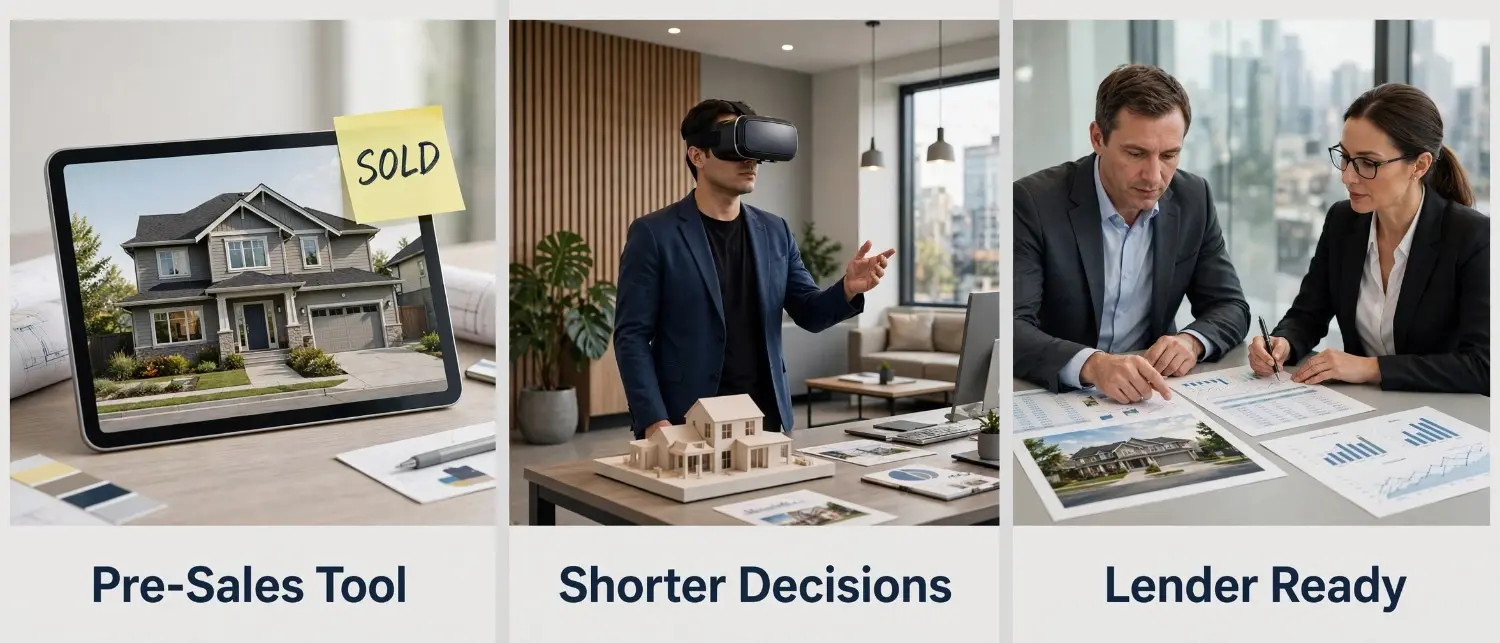
There is also a measurable financial argument behind this shift. Pre-sales revenue, even at a deposit level, improves a builder’s negotiating position with construction lenders and reduces the amount of speculative capital tied up in a project. A rendering package that convincingly sells a home before the frame is up can shorten the gap between land acquisition and positive cash flow, which matters more in a higher interest rate environment where carrying costs compound quickly. Developers who once viewed rendering as a discretionary marketing line are now building it into their initial project pro forma alongside site work and permitting costs.
Sales teams also report a secondary benefit: renderings reduce the volume of repetitive buyer questions during walk-throughs and open houses. When a prospective buyer has already explored a twilight render, an aerial site plan, and an interactive configurator online, the in-person or virtual sales conversation shifts from basic orientation to deeper questions about financing, timelines, and customization. That shift alone can shorten the average sales cycle by weeks on custom and semi-custom projects.
Top US Residential Architecture Rendering Trends to Watch
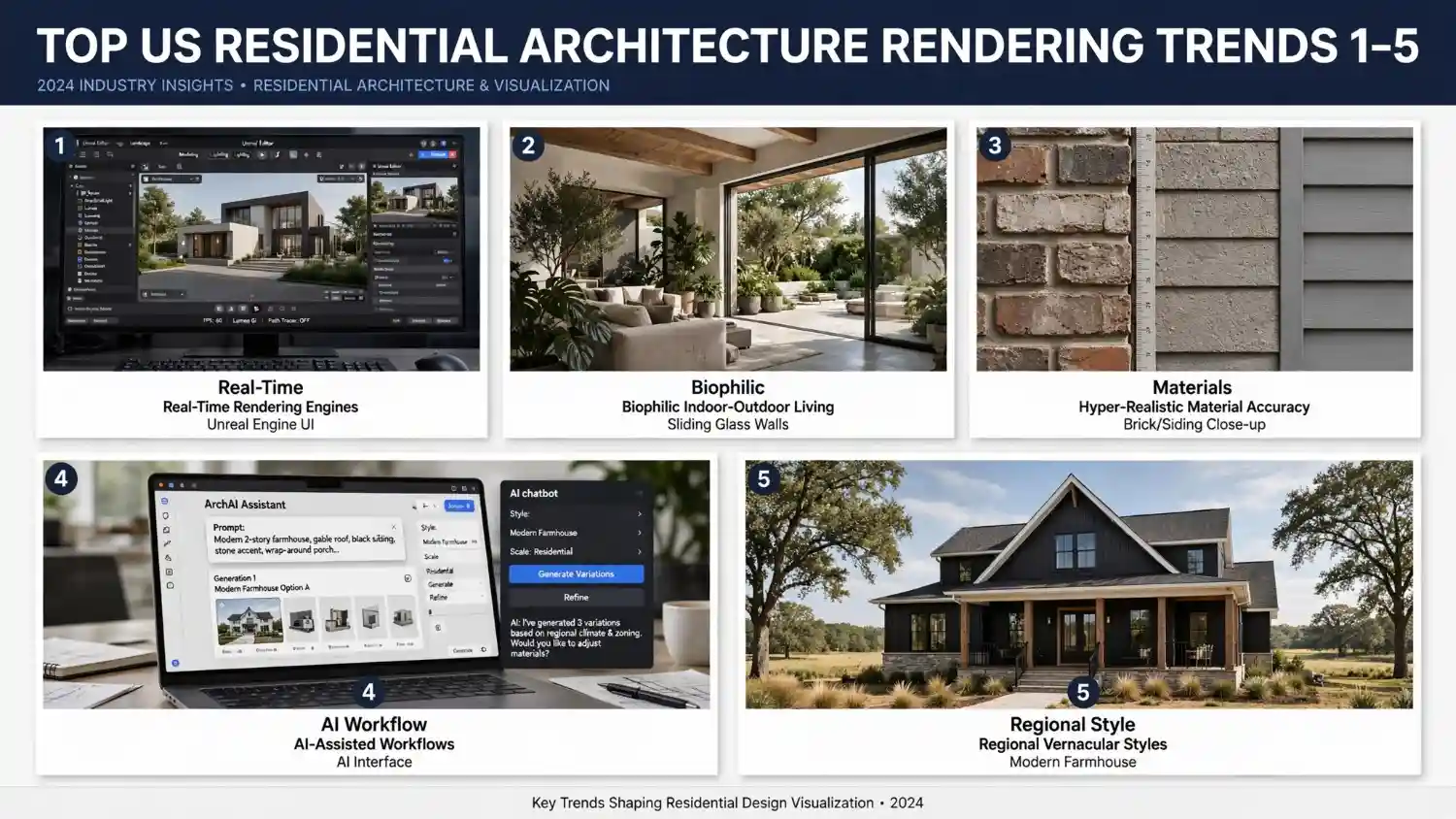
Below are the ten trends most frequently requested by builders, architects, and marketing teams working on single-family, custom, and multifamily residential projects across the US.
1. Real-Time Rendering Engines Replace Static Walkthroughs
Real-time engines such as Unreal Engine, Enscape, and Twinmotion let a client walk through a home from any angle, adjust the time of day, and swap finishes on the spot during a sales meeting. Static, single-frame images are increasingly treated as one deliverable among many rather than the entire package.
Builders serving single-family home developments are particularly quick to adopt this format because it lets sales teams personalize a presentation for each prospective buyer without commissioning a new render from scratch.
The practical advantage shows up most clearly during live sales conversations. A sales representative can pull up a real-time scene on a tablet, rotate the model to show a buyer their exact lot orientation,
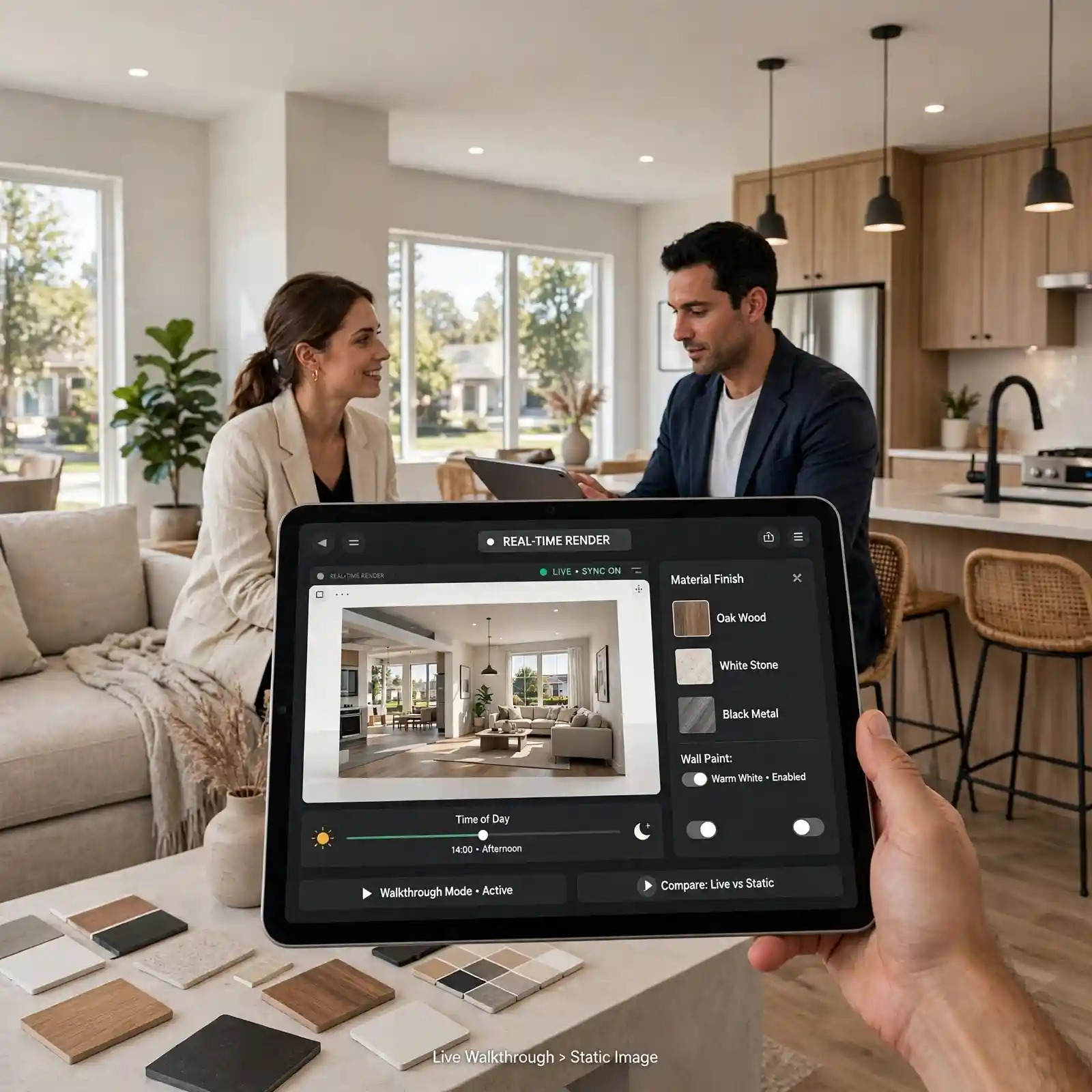
and swap the exterior color scheme in seconds rather than waiting days for a new static render. For builders managing several elevations across a single subdivision, this single real-time file often replaces what used to require a dozen separate rendered images, cutting both cost and turnaround time considerably.
2. Biophilic and Indoor-Outdoor Living Visualizations
Buyers continue to prioritize homes that blur the line between interior and exterior space. Renderings now emphasize large sliding glass walls, covered outdoor kitchens, and native landscaping that ties the structure to its lot. This trend reflects a broader shift in residential design toward wellness-oriented, nature-integrated living spaces, a direction the U.S. Green Building Council has also documented in its research on healthy building design.
Rendering studios are responding by investing more time in landscape asset libraries: mature tree species accurate to a specific US region, native grasses, and hardscape textures that match actual regional stone and paver suppliers rather than generic library assets. This attention to landscaping realism often makes the difference between a render that looks like a stock illustration and one that looks like an actual, buildable property.
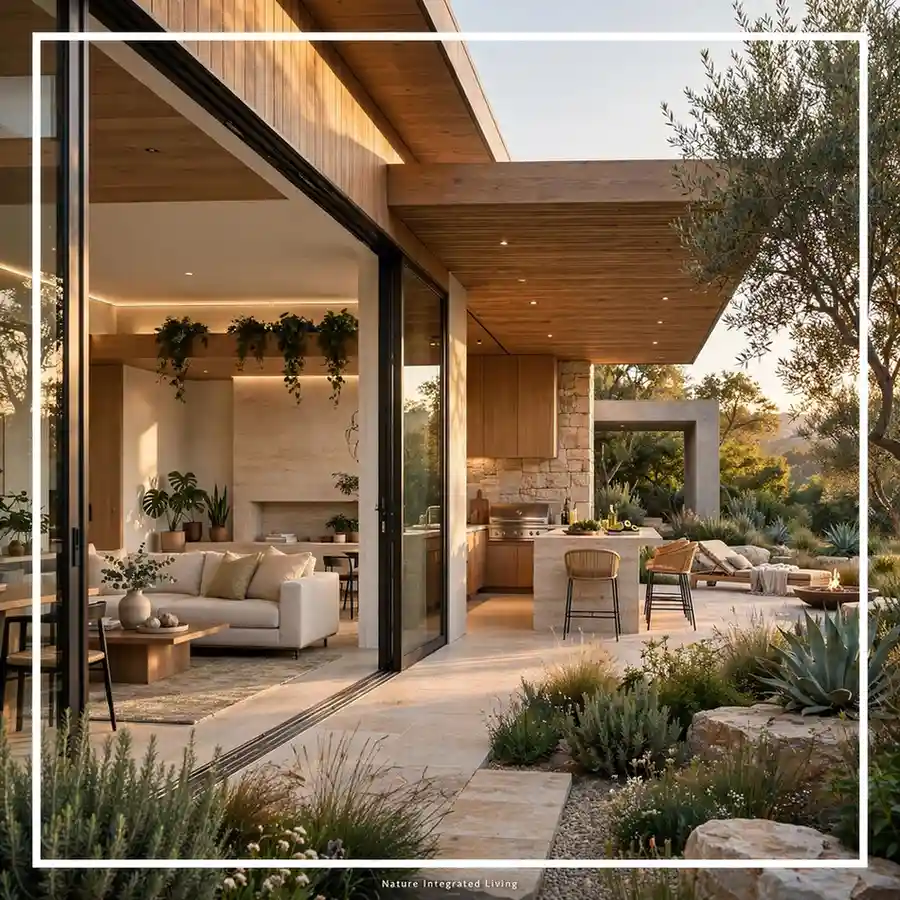
Builders marketing custom or luxury lots in particular are requesting landscaping revisions as a standard part of their review cycle rather than treating planting as an afterthought layered on at the end.
3. Hyper-Realistic Material and Lighting Accuracy
Clients are no longer satisfied with generic stucco or siding textures. They expect renderings to reflect the exact brick, board-and-batten, or metal roofing samples specified in the construction documents. Physically based rendering (PBR) materials paired with accurate global illumination now let a single image double as a material approval tool for the builder and subcontractors.
This has a downstream effect on how renderings are used internally, not just for buyer-facing marketing. Superintendents and procurement teams increasingly reference the same rendering used in a marketing brochure to confirm siding color, roofing profile, and window trim before placing material orders. When a rendering studio has access to the actual manufacturer spec sheet, whether that is a specific fiber-cement siding line or a named roofing shingle color,
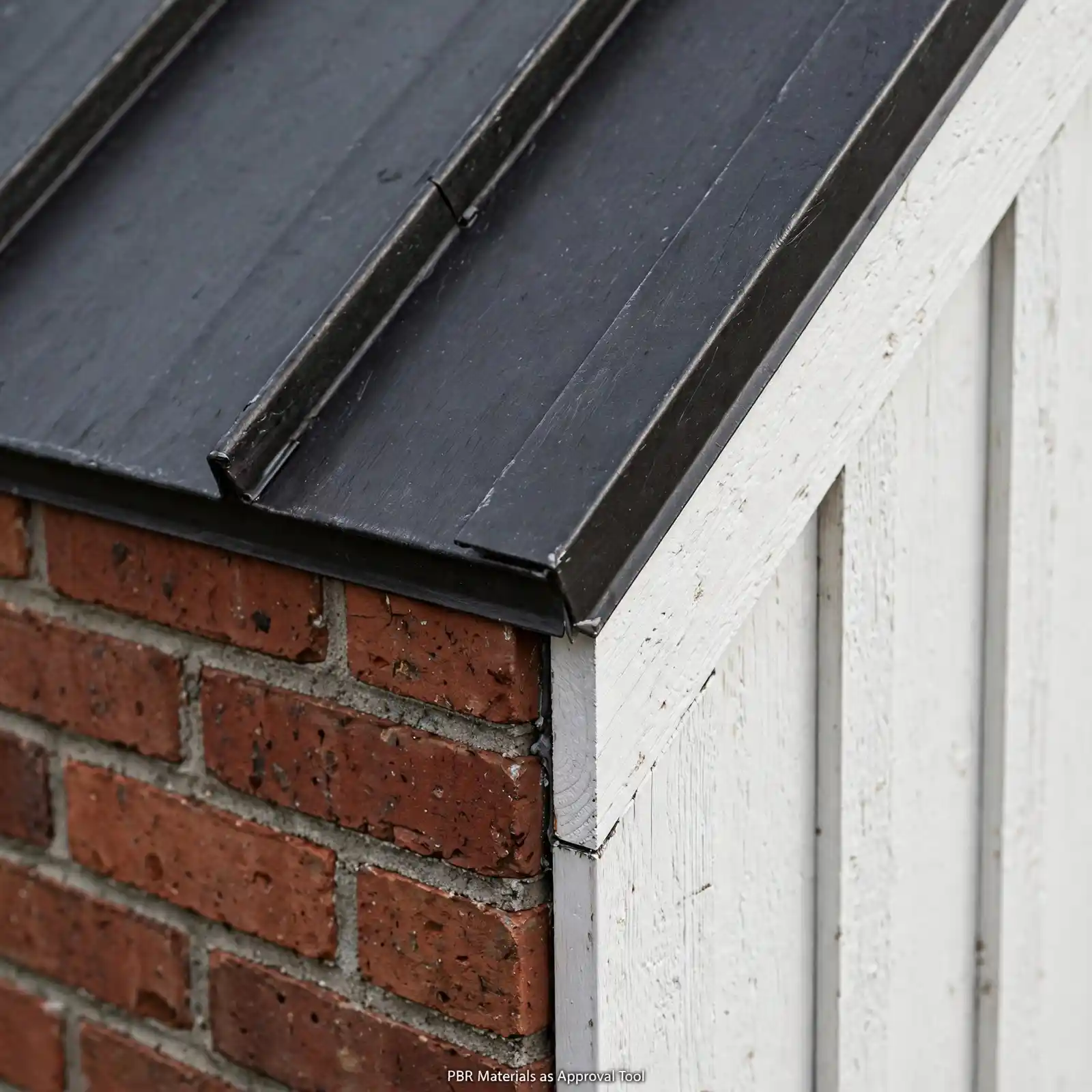
the resulting image reduces the risk of a mismatch between what was marketed and what gets built.
4. AI-Assisted Rendering Workflows
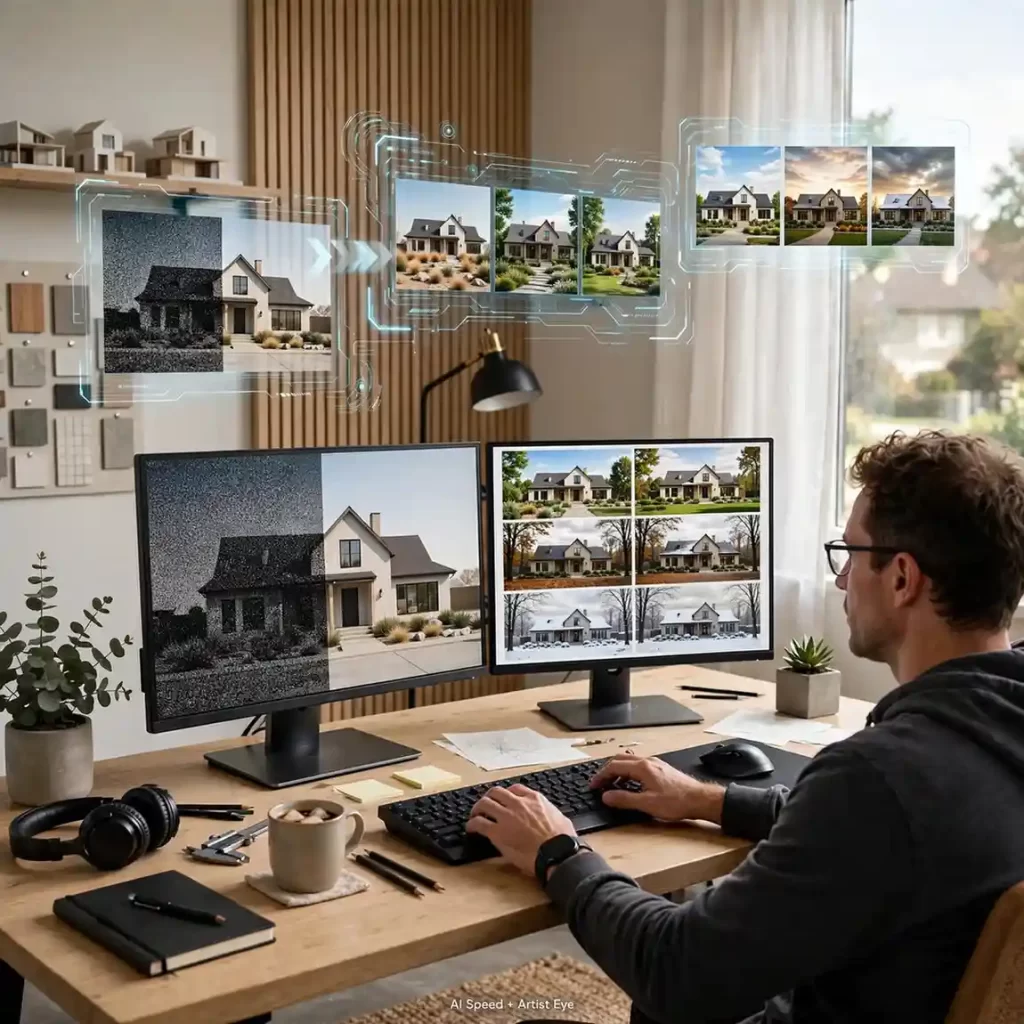
AI upscaling, denoising, and generative in-painting tools have cut production time on repetitive tasks like landscaping variations, sky replacements, and seasonal changes. This does not replace the artist; rather, it frees the visualization team to spend more time on lighting, composition, and client-specific revisions instead of manual cleanup work.
For builders, the practical benefit is turnaround speed on revision requests. A change that once meant re-rendering an entire scene from scratch, such as swapping a summer landscaping scheme for a fall variation, can now often be produced as a variant of an existing base render in a fraction of the original production time. This matters most for developers running seasonal marketing campaigns or A/B testing different exterior color schemes across paid social channels, where speed of iteration directly affects marketing budget efficiency.
5. Modern Farmhouse, Contemporary Craftsman, and Regional Vernacular Styles
Style requests vary heavily by region, but the common thread nationally is a move away from purely generic elevations toward styles rooted in regional vernacular: coastal shingle styles in the Northeast, contemporary desert modern in the Southwest, and modern farmhouse across the Midwest and South. Renderings need to reflect these regional material and roofline conventions accurately, or the marketing image will feel out of place to local buyers.
A rendering studio that understands these regional distinctions can flag inconsistencies before they reach a buyer’s screen, such as a steep-pitch roofline that reads as out of place in a low-snow-load region, or a stucco finish that a coastal buyer would not associate with the local architectural vocabulary.
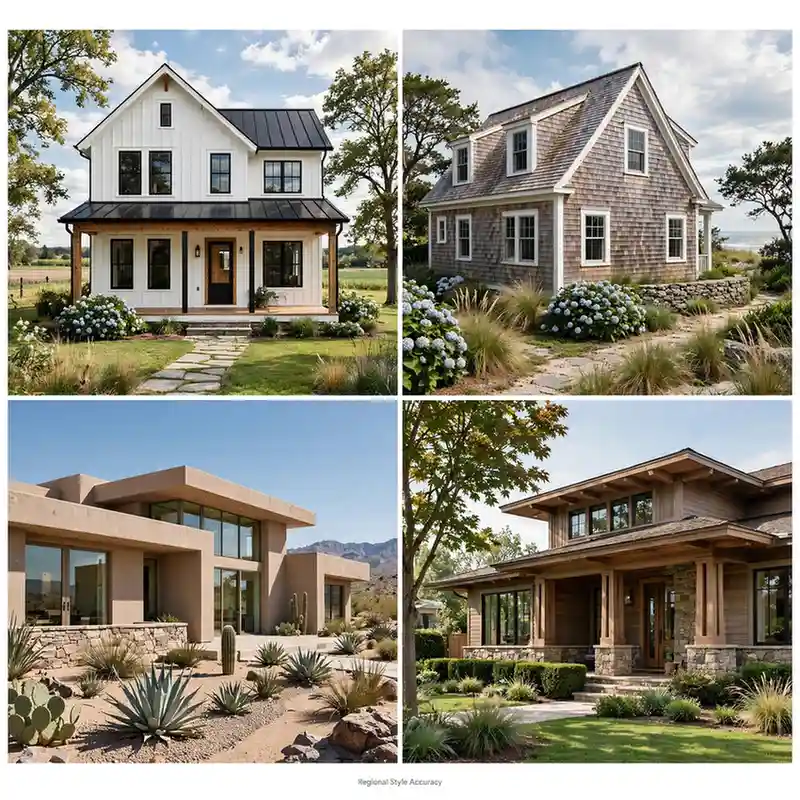
Builders operating across multiple states are increasingly asking their rendering partner to maintain a regional style guide alongside their brand style guide, ensuring every project lands correctly with its local buyer pool.
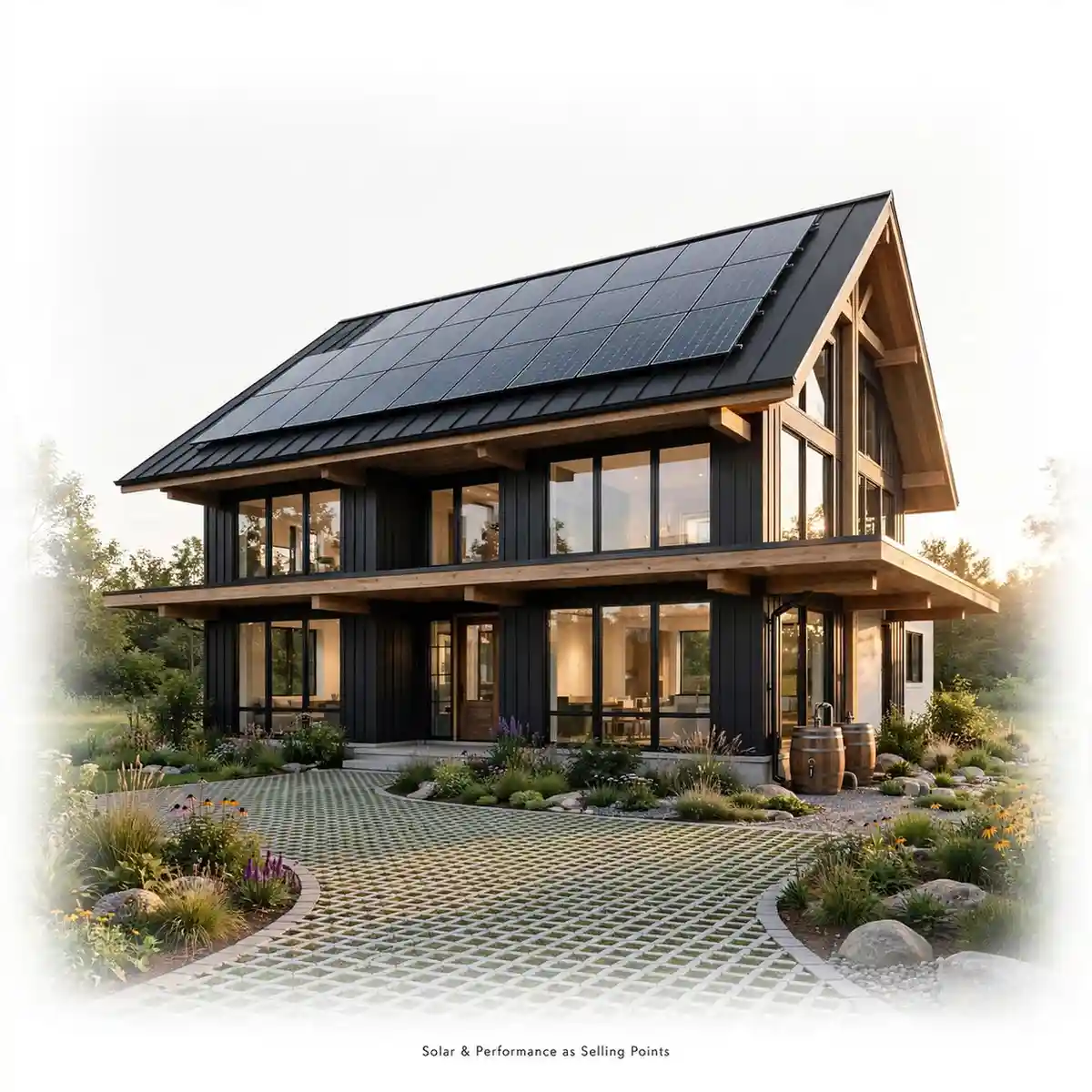
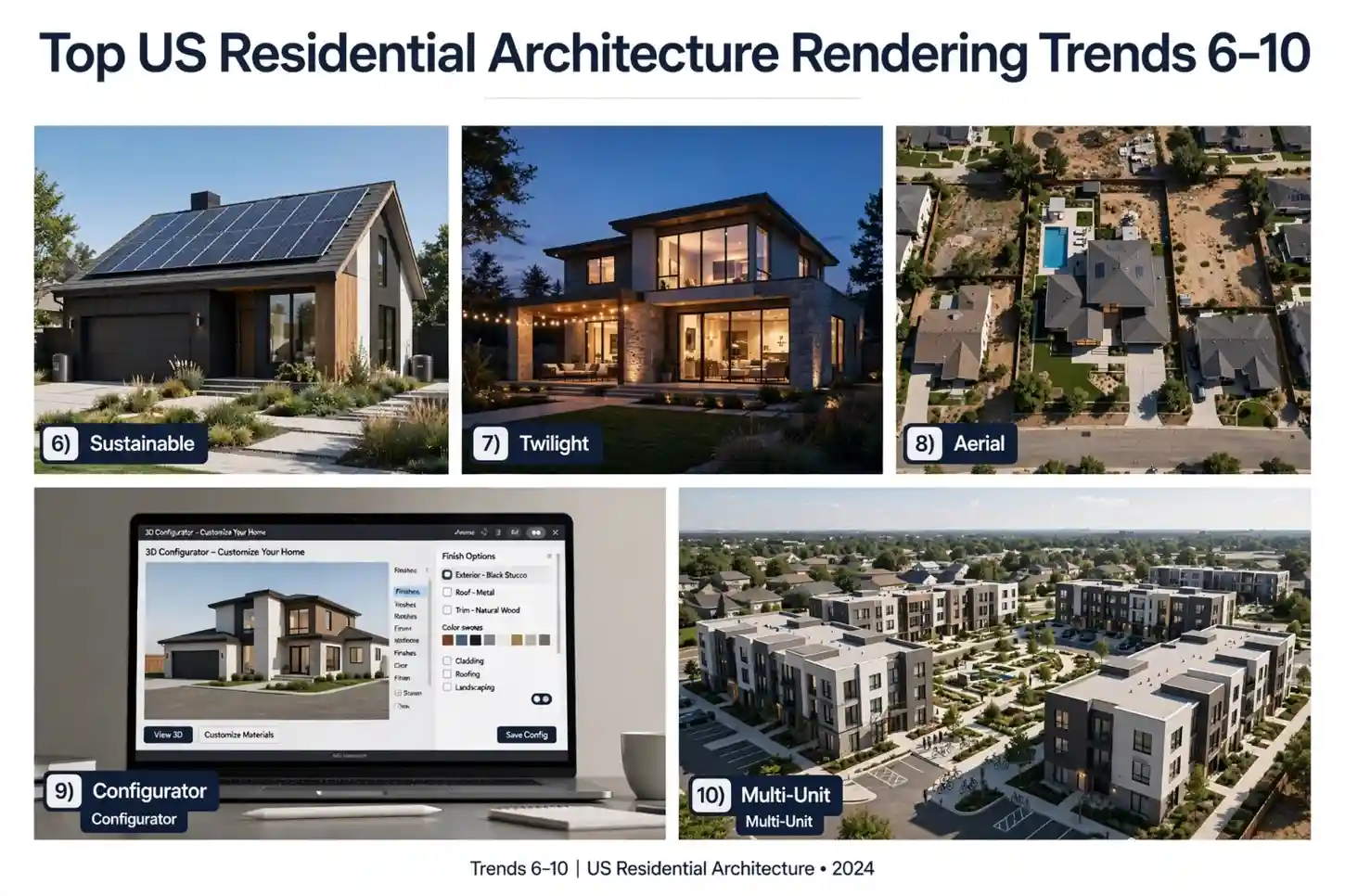
6. Sustainable and Net-Zero Design Visualization
Solar arrays, rainwater harvesting systems, and high-performance glazing are increasingly shown as selling points rather than hidden technical details. According to the National Association of Home Builders, sustainable and energy-efficient features remain a growing priority among buyers, and renderings are adapting to visualize these systems clearly rather than omitting them for a cleaner image.
This means rendering teams now routinely model rooftop solar arrays with correct panel counts and orientation, permeable paving in driveways, and shaded overhangs sized to match actual passive-cooling calculations rather than an approximate visual guess. Builders marketing to environmentally conscious buyers, particularly in states with strong solar adoption rates, are finding that an accurately rendered solar array photographs better and builds more buyer trust than a vague mention of “energy-efficient features” in a listing description.
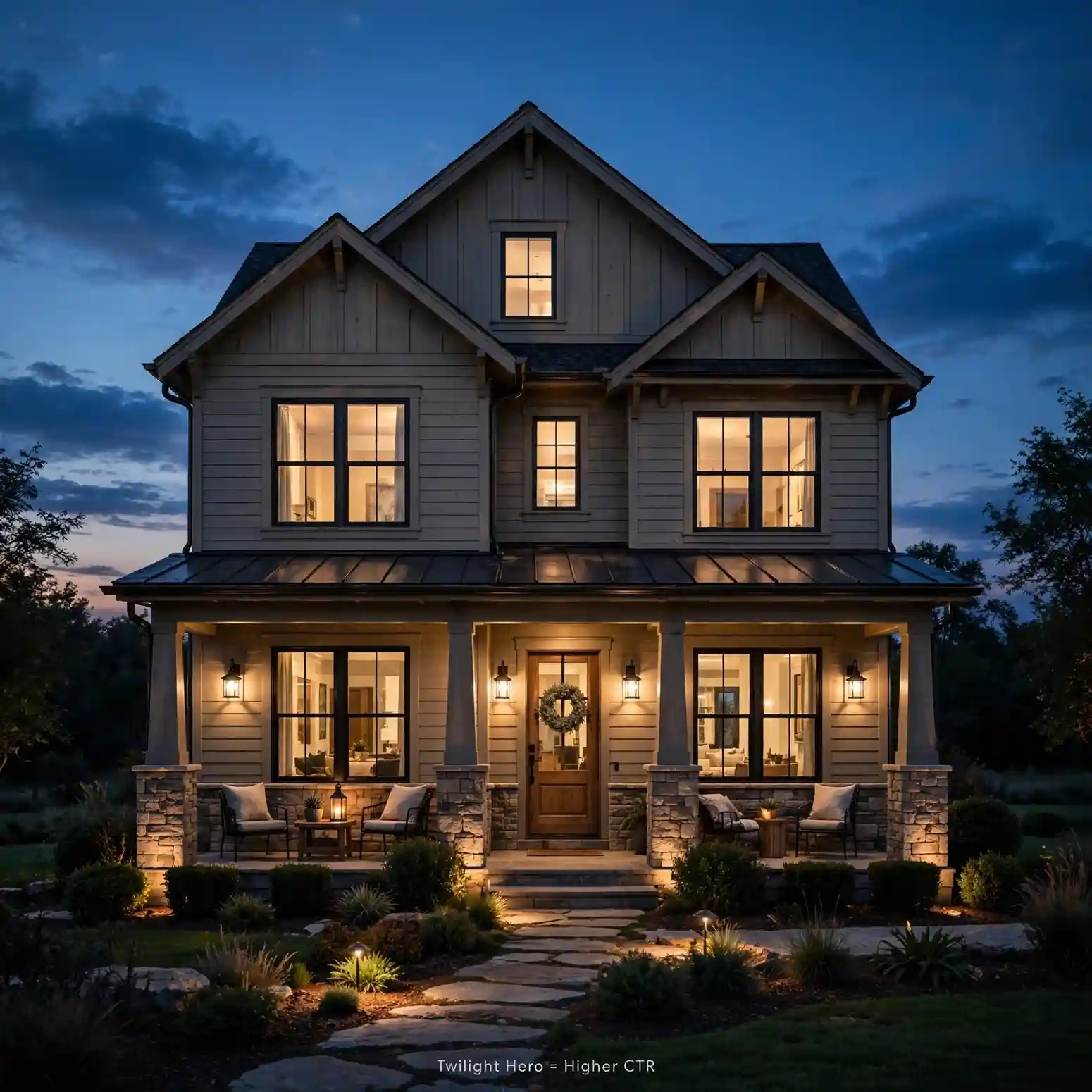
7. Twilight and Dusk Renders for Emotional Marketing
Dusk and twilight lighting scenes, warm interior glow spilling through windows against a darkening sky, continue to outperform flat daylight renders in social media engagement and listing click-through rates. Marketing teams are requesting at least one twilight hero shot per project as a standard deliverable rather than an upsell.
The reason is largely psychological rather than technical. A twilight scene signals that a home is already lived in, complete, and welcoming, which tends to trigger a stronger emotional response than a flat midday image of the same structure. Builders running paid social campaigns frequently report that a twilight hero image outperforms daylight equivalents on click-through rate, which has pushed many marketing teams to request twilight as the primary listing image rather than a secondary supporting shot.
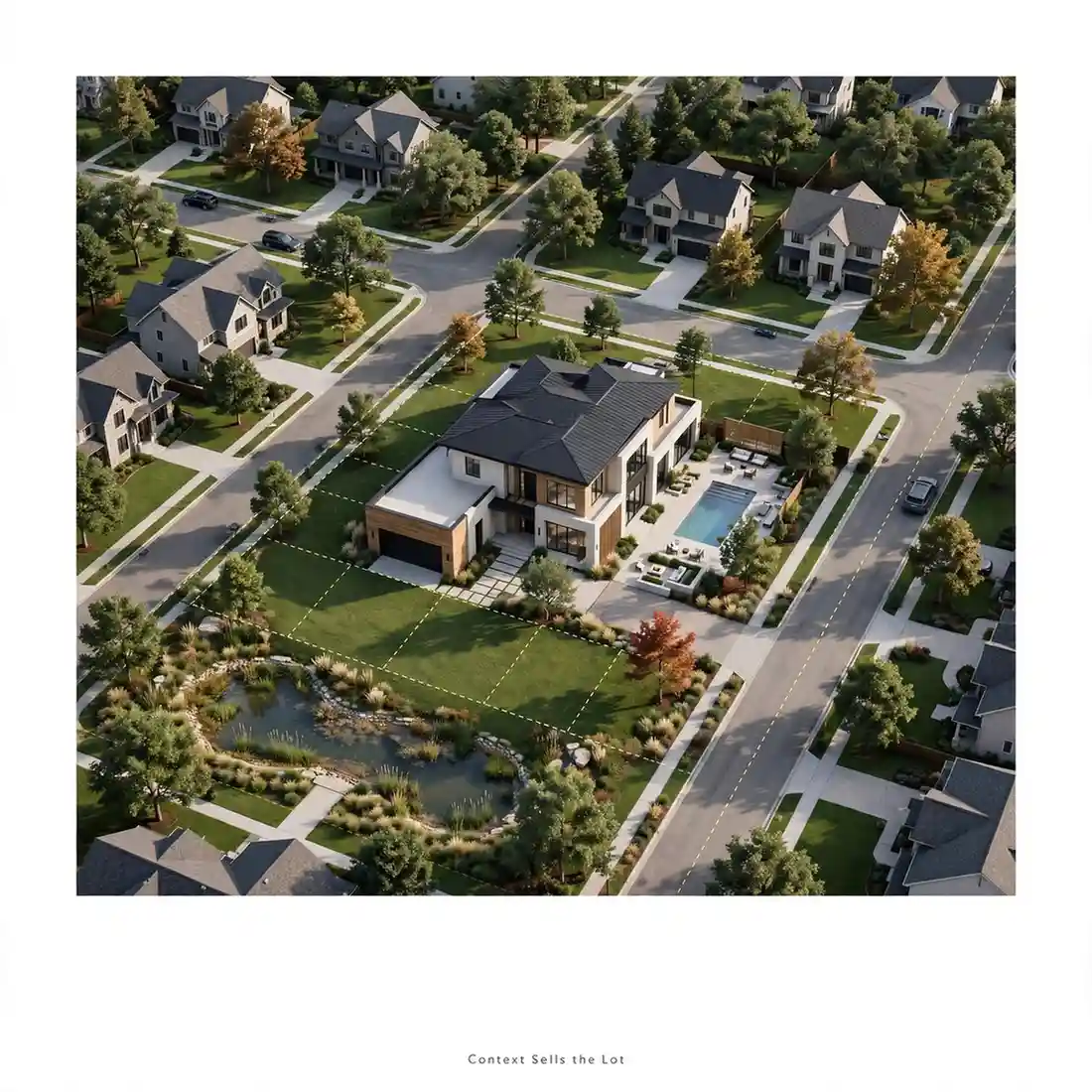
8. Drone-Perspective and Aerial Site Renders
As lot context becomes a bigger part of the buyer decision, especially for larger custom homes and rental communities, aerial and drone-angle renderings that show the property within its neighborhood or site plan are in higher demand. These are especially valuable for purpose-built rental communities where site layout and shared amenities are a core selling point.
Aerial renders also serve a practical role beyond marketing: they help lenders and municipal reviewers understand setbacks, shared drive access, and stormwater layout at a glance, which can speed up entitlement conversations that would otherwise require reading a two-dimensional civil site plan. A well-produced aerial rendering effectively functions as a translation layer between technical site documents and the non-technical stakeholders who need to approve or invest in a project.
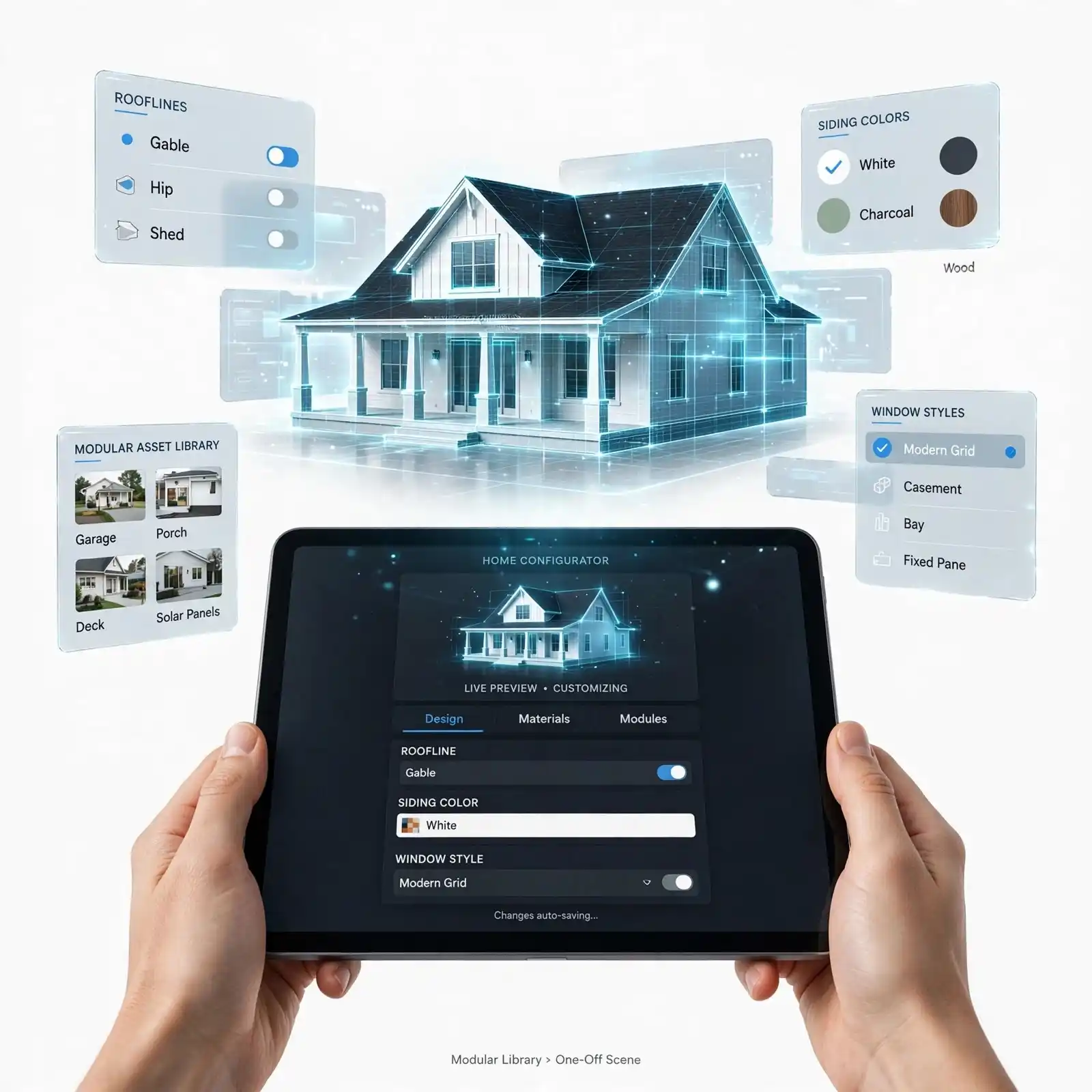
9. Interactive 3D Configurators for Buyers
Builders selling multiple elevations or finish packages on the same lot are increasingly offering web-based configurators where buyers can toggle rooflines, siding colors, and window styles. This trend pushes rendering providers to build modular asset libraries rather than one-off scenes, since each option needs to render cleanly in combination with every other option.
Building a configurator well requires more upfront planning than a single hero render, since every material and color combination needs to look believable under the same lighting setup. Studios that specialize in this format typically build a base scene once and then layer swappable material variants on top, which keeps costs manageable for the builder even as the number of buyer-facing options grows. Once built, this asset library can be reused across an entire subdivision or product line rather than a single home, extending its value well beyond the initial sales launch.
10. Multi-Unit and Purpose-Built Rental Community Renders
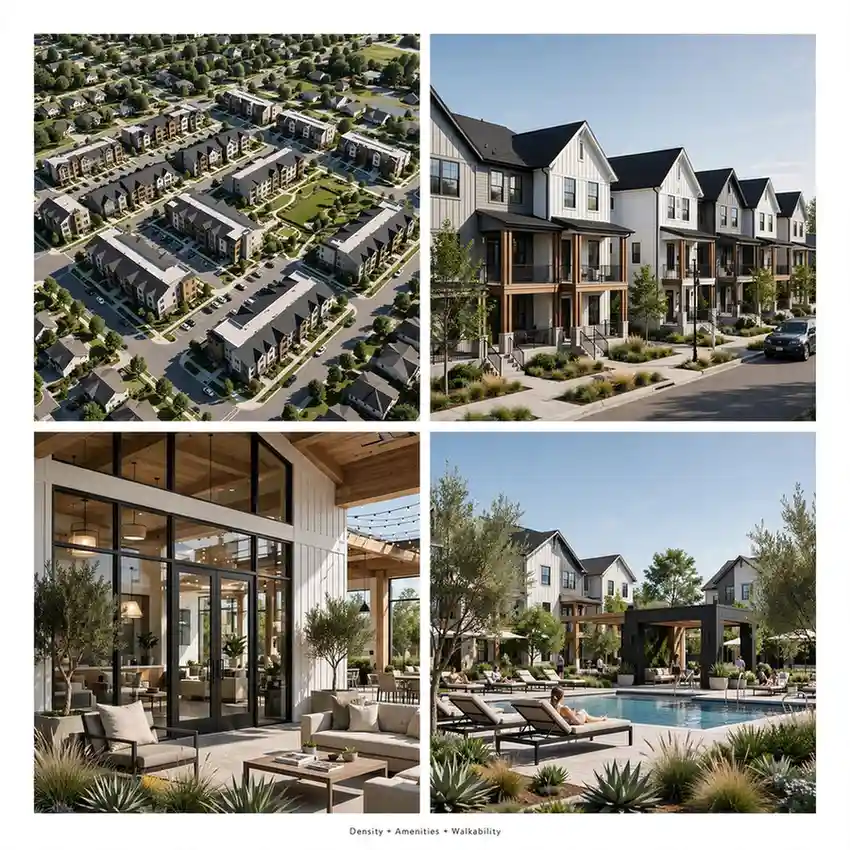
Multifamily and build-to-rent developers need renderings that communicate density, shared amenities, and street-level walkability simultaneously. This has led to a rise in composite renderings that combine an aerial context shot, a street-level hero image, and an amenity-focused close-up in a single presentation deck.
Leasing teams in particular rely on these composite decks during pre-leasing campaigns, where the goal is to sign tenants months before a community opens. A rendering package that clearly shows a clubhouse, pool deck, and street-level unit facade in one cohesive presentation tends to convert better than a single wide-angle image, since prospective renters can quickly see the parts of a community that matter most to their daily routine.
Rendering Engine Comparison for US Residential Projects
Choosing the right engine depends on whether the priority is photorealism, speed, or interactivity. The table below summarizes how the most common engines compare for residential exterior work.
| Rendering Engine | Best For | Turnaround Speed | Photorealism Level | Interactive Walkthrough |
|---|---|---|---|---|
| V-Ray | Hero marketing stills, material accuracy | Slower (offline) | Very High | No |
| Corona | Natural lighting, daylight studies | Slower (offline) | Very High | No |
| Enscape | Real-time client walkthroughs | Fast | High | Yes |
| Twinmotion | Landscaping-heavy scenes, quick iteration | Fast | High | Yes |
| Lumion | Large site and community renders | Fast | Moderate-High | Yes |
| Unreal Engine | Fully interactive configurators | Moderate setup, fast output | Very High | Yes |
For a deeper technical breakdown of how these engines perform on exterior-specific projects, see the comparison of the best rendering engines for exterior architectural visualization.
Common Mistakes Builders Make With Exterior Renderings
Avoid these recurring issues when commissioning residential exterior renders:
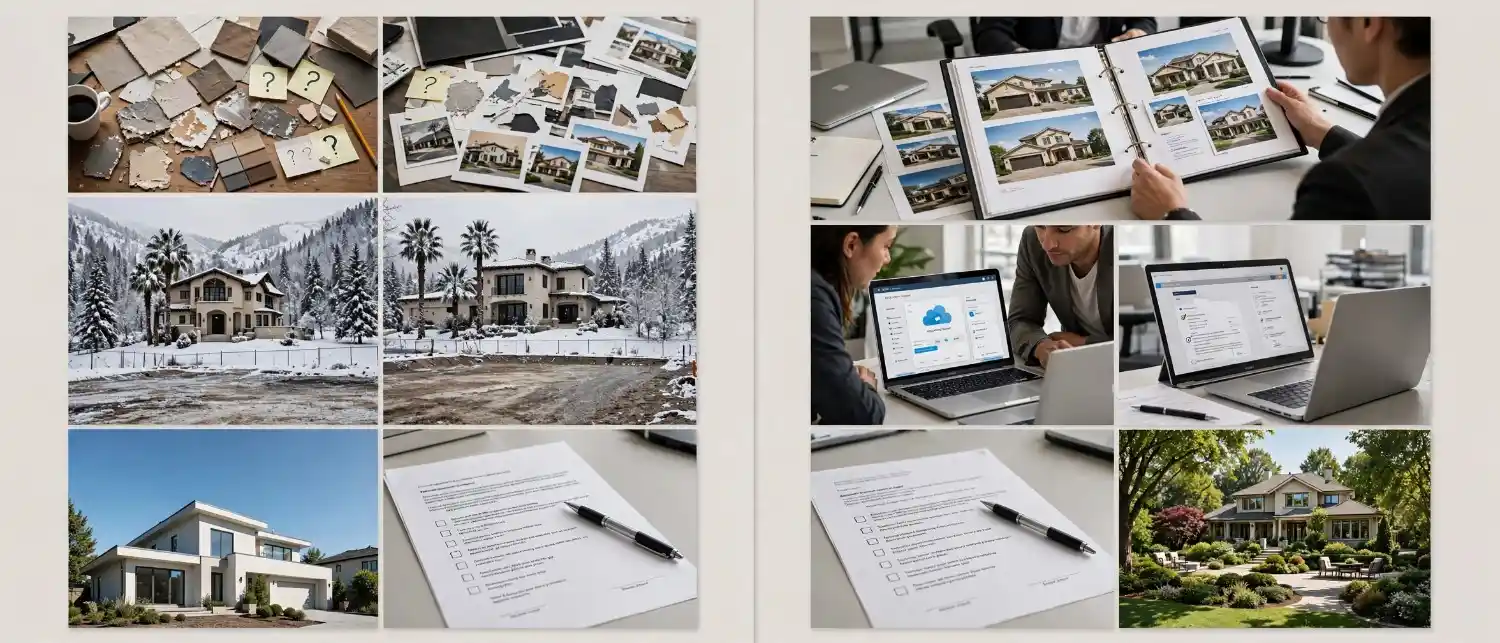
Mistake #1 Skipping material samples
Sending a rendering team vague finish descriptions instead of actual spec sheets leads to costly revision rounds.
Mistake #2 Ignoring regional context
A style rendering that ignores local zoning, roofline conventions, or climate cues can alienate local buyers.
Mistake #3 Treating renderings as a single deliverable
Ordering one static image instead of a package that includes daylight, twilight, and aerial angles undersells the project.
Mistake #4 Underestimating landscaping
Bare lots with no mature planting context make a home look smaller and less inviting than it will be at completion.
Mistake #5 Waiting too long to start
Beginning the rendering process only after construction starts eliminates its biggest advantage: pre-sales and pre-leasing.
Mistake #6 Requesting only daytime views
Skipping twilight and aerial angles limits how the same rendering package can be reused across different marketing channels later on.
Mistake #7 Approving renders without a fresh set of eyes
A design team that has stared at the same elevations for months can easily miss a detail a first-time buyer would notice immediately.
Avoiding these mistakes tends to matter more for overall project ROI than chasing the newest rendering technology, since a technically excellent render built on the wrong assumptions still fails to convert buyers.
Expert Tips for Choosing a Rendering Partner
Ask for a residential-specific portfolio
Commercial and residential exterior rendering require different lighting, scale, and landscaping sensibilities.
Confirm revision policy upfront
Most reputable studios include two to three revision rounds; unlimited revisions without scope limits often signal an inefficient workflow.
Request real-time files, not just final images
A studio that hands over the interactive model, not only rendered stills, gives long-term value across multiple marketing channels.
Clarify turnaround before committing to a launch date
Marketing timelines should be built around realistic rendering delivery windows, not the reverse.
Compare pricing against scope, not just per-image cost
For a full breakdown of what affects cost, see this 3D exterior rendering cost and price guide.
Check whether landscaping and site context are included
Some studios price bare-structure renders separately from full site and landscaping context, which can make an initial quote look lower than the final delivered cost.
These questions matter most for builders planning multiple projects with the same partner, since a rendering relationship built on clear expectations tends to produce faster turnaround and fewer revision cycles over time.
Step-by-Step: How the Residential Exterior Rendering Process Works
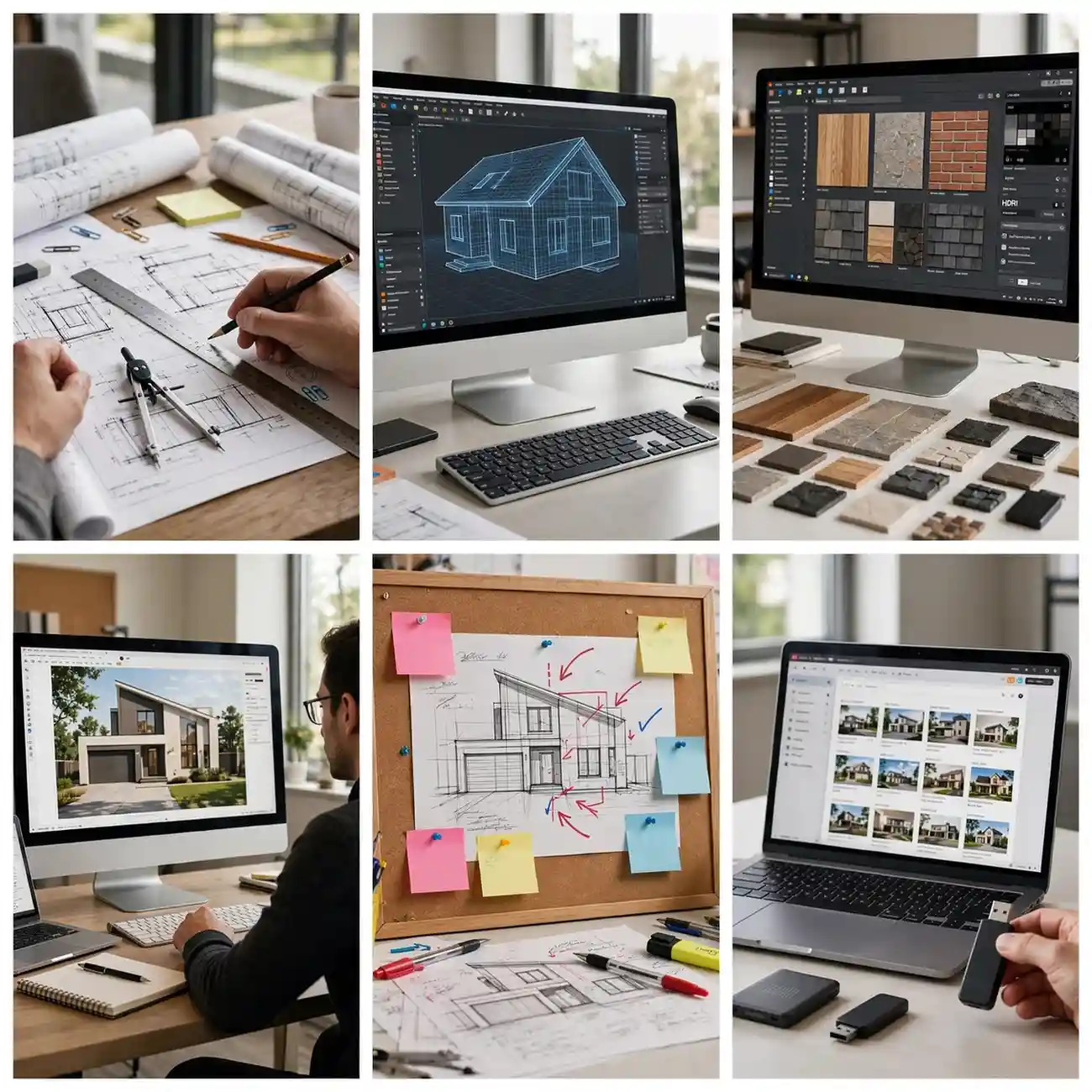
- Design intake. The studio collects architectural drawings, material specs, and site plans.
- 3D modeling. A base model of the structure and surrounding site is built to scale.
- Material and lighting setup. Textures, landscaping, and lighting conditions (daylight, dusk, or aerial) are applied.
- Draft review. The client reviews a preliminary render for massing, angle, and material accuracy.
- Revisions. Feedback is incorporated, typically across one to two rounds.
- Final delivery. High-resolution stills, and where applicable, interactive walkthrough files, are delivered for marketing and sales use.
This process is covered step by step in greater technical detail in the studio’s 3D exterior rendering workflow guide.
How These Trends Impact Real Estate Pre-Sales and Marketing
Rendering trends do not exist in a vacuum; they directly shape how homes get marketed and sold before completion. Builders using twilight renders, interactive configurators, and aerial context shots are seeing these assets used across listing platforms, social media, and investor decks simultaneously. For a closer look at how these visuals are deployed across the sales funnel, see how 3D exterior renderings are used in real estate pre-sales campaigns.
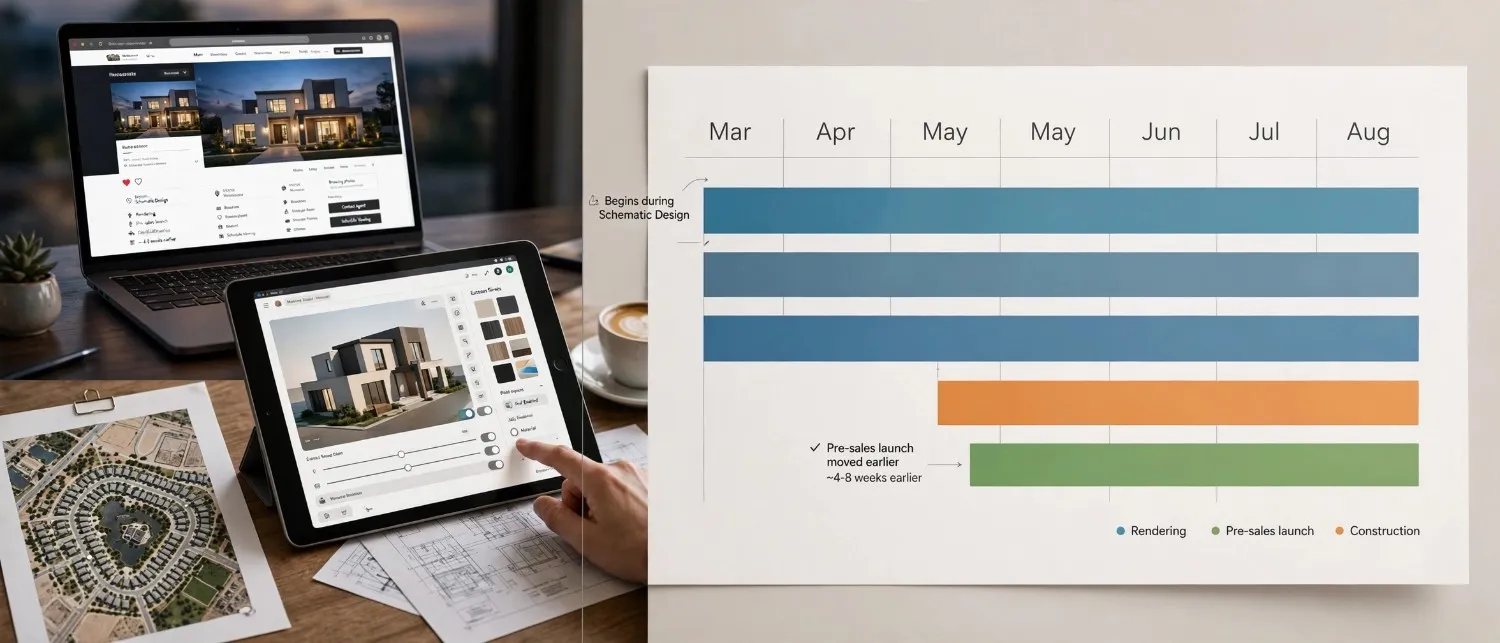
Planning Rendering Into Your Project Timeline
One practical question builders ask less often than they should is when, exactly, rendering should start relative to the rest of the design and construction schedule. The most common mistake is treating rendering as a task that happens after architectural drawings are fully locked, which pushes the marketing launch date later than it needs to be.
A more effective approach is to start the rendering process as soon as schematic design and material selections are far enough along to be reliable, even if some interior finishes are still being finalized. This allows the rendering studio to build the base 3D model in parallel with later-stage architectural work, so that by the time construction documents are complete, only material and lighting refinements remain before final delivery. Builders who plan this way typically launch pre-sales marketing four to eight weeks earlier than those who wait for full design completion, a difference that can matter significantly in a fast-moving market.
Frequently Asked Questions
What are the biggest US residential architecture rendering trends right now?
Real-time rendering engines, AI-assisted workflows, biophilic and indoor-outdoor visualizations, twilight renders, and interactive 3D configurators are the trends currently shaping how residential projects are presented to buyers and lenders.
Why do homebuilders need 3D exterior renderings before construction?
Renderings let builders market, pre-sell, and secure financing for homes before a single foundation is poured, which reduces risk and speeds up the overall sales cycle.
How long does a US residential exterior rendering take to produce?
A single hero rendering typically takes three to seven business days, depending on complexity, revision rounds, and whether real-time or offline engines are used.
Which rendering engine is best for residential exteriors?
V-Ray and Corona remain preferred for photorealistic offline quality, while Enscape, Lumion, and Twinmotion are favored for fast, real-time, buyer-facing walkthroughs.
Do renderings need to match the final construction materials exactly?
Yes. Increasingly, renderings double as a material approval step, so accuracy in siding, roofing, and trim details helps avoid mismatched expectations at handover.
Can one rendering package be reused across multiple marketing channels?
Yes, when a package is built with real-time or modular assets, the same base scene can generate social media crops, listing photos, investor deck stills, and interactive walkthroughs without commissioning separate renders for each channel.
Conclusion
US residential architecture rendering trends in 2026 all point in the same direction: faster, more interactive, and more accurate visualization that supports sales from the earliest stage of a project. Real-time engines, AI-assisted revisions, material-accurate detailing, and emotionally resonant twilight and aerial imagery are no longer optional extras, they are becoming the baseline expectation for any builder marketing a home before it exists. Builders who treat rendering as a strategic marketing asset, not an afterthought, are converting those visuals into shorter sales cycles, stronger lender confidence, and higher buyer conversion rates across every channel where a home is presented digitally.
The firms that adapt fastest to these trends will be the ones setting the visual standard their competitors have to match over the next several years. If your next project needs a rendering partner who stays current on these trends, get a free project quote from The 3D Exterior Rendering Company and see how a modern rendering package can accelerate your next launch.
IBogpoNGcPfUdBsOtheo