
3D exterior rendering pre-sales real estate campaigns use photorealistic images of a building’s exterior, produced before construction begins, to secure reservations, qualify leads, and validate design decisions with target buyers. Developers deploy these renders across landing pages,
brochures, and paid media to compress the sales cycle for off-plan units. Lenders, brokers, and buyers all evaluate the same visual asset for a project that does not yet physically exist.
Firms exploring professional 3D exterior rendering services for an upcoming launch typically map renders directly to each stage of the buyer journey, starting with land approval and continuing through move-in. That mapping is what turns a single rendering package into a full pre-sales campaign rather than a one-off marketing image.
This guide breaks down exactly where 3D exterior rendering fits into a pre-sales real estate campaign, the mistakes that quietly undercut its return, and the practical steps that keep a rendering-led launch on schedule.
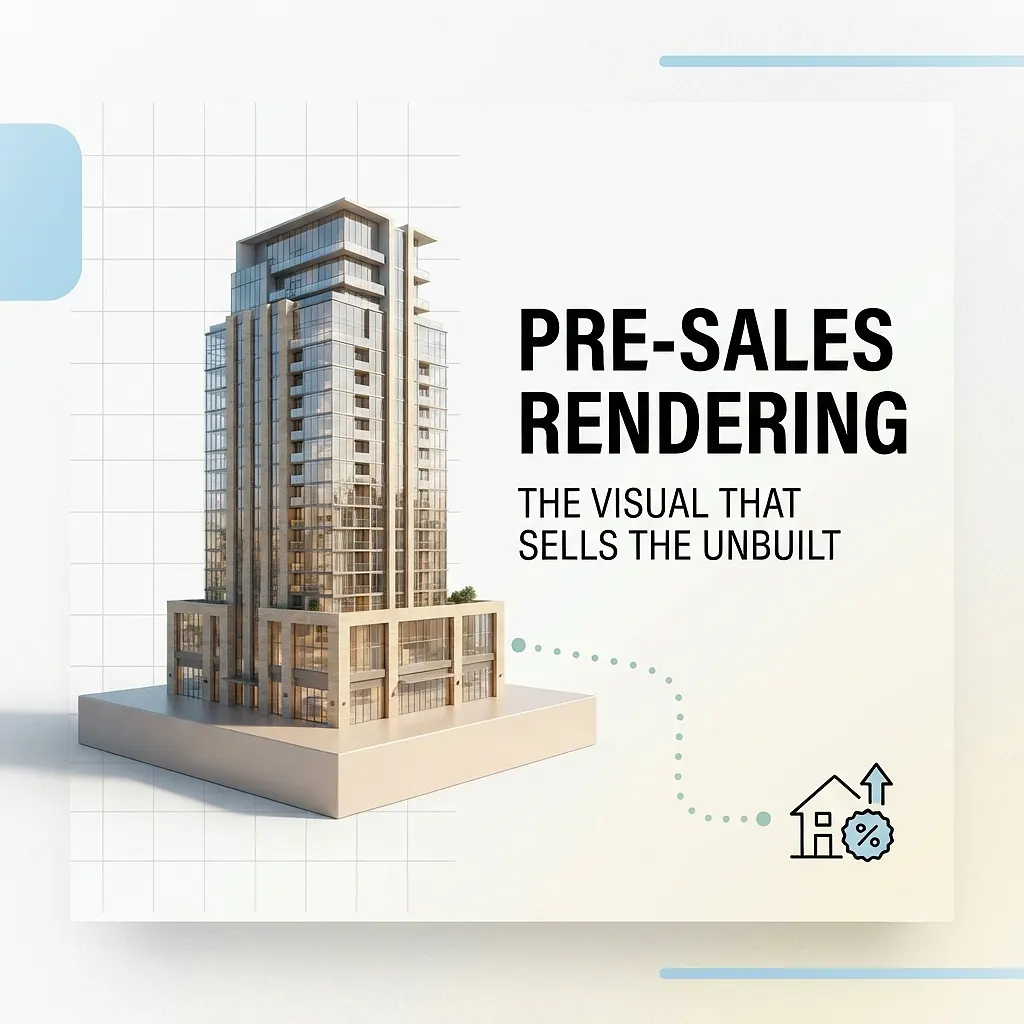
What is 3D Exterior Rendering in Real Estate Pre-Sales?
3D exterior rendering in real estate pre-sales is the creation of computer-generated, photorealistic images of a building’s facade, massing, and site context, used to market a property before it is built. Instead of relying on architectural elevations or artist sketches, developers commission full-color, lighting-accurate renders that show the finished product from the angles buyers actually care about: the street approach, the entry sequence, and the skyline or neighborhood context.
Because pre-sales renders are produced from design development or construction drawings, they can be generated well before a single foundation is poured. That timing advantage is precisely why rendering has become the default visual language for off-plan marketing, not an optional add-on to it.
Why 3D Exterior Rendering Matters for Pre-Sales Campaigns
A pre-sales campaign has to sell a promise, not a finished product. Renders close that gap in several concrete ways:
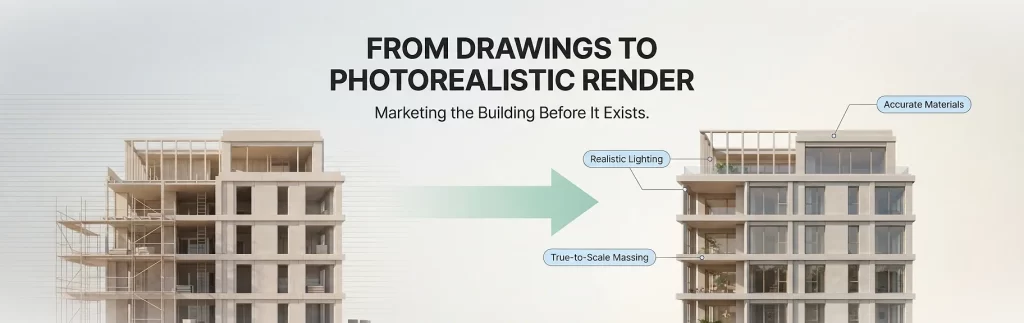
- Faster buyer decisions – a photorealistic view removes the guesswork that floor plans and text descriptions leave behind.
- Stronger investor and lender confidence – financing partners can assess massing, materials, and site integration before construction draws are approved.
- Consistent messaging across channels – the same core render set can be reused across the website, social ads, print collateral, and the sales gallery.
- Design validation before it’s expensive to change – stakeholders can flag facade or material concerns while revisions are still cheap.
- Earlier marketing start date – campaigns can launch months before a physical model unit or show suite exists.
How 3D Exterior Renderings Power Each Stage of a Pre-Sales Campaign
Most successful pre-sales campaigns route the same core rendering set through five distinct stages. Here’s how that typically plays out:
WHERE RENDERING FITS THE PRE-SALES TIMELINE
1. Land Acquisition and Feasibility
Early massing studies help developers and site-selection teams judge how a proposed building will read from key streets before a purchase agreement is even signed. At this stage, renders are often simplified, focused on scale and site fit rather than final material finishes.
2. Investor and Lender Presentations
Once a site is secured, more refined exterior renders support pitch decks and loan packages. Lenders increasingly expect a polished visual, not a line drawing, before committing to a construction loan.
3. Marketing Launch and Landing Pages
This is where most pre-sales budgets go. Hero renders anchor the project website, paid social campaigns, and geo-targeted display ads, usually paired with a registration form to capture qualified leads ahead of launch day.
4. Sales Gallery and Buyer Walkthroughs
Large-format prints, video flythroughs, and interactive walkthroughs built from the same exterior render set give in-person prospects a consistent, high-resolution view of the finished building.
5. Reservation and Closing
As buyers move toward signing, updated renders (reflecting any late design refinements) reassure them the project they reserved months earlier is still on track and unchanged in the ways that matter to them.
Where Pre-Sales Renderings Get Used
A single rendering package rarely stays in one place. Once approved, the same visual asset typically shows up in:
- Project websites and dedicated landing pages
- Paid social and display advertising
- Print brochures and investor decks
- Sales gallery displays and lightboxes
- Broker and MLS-style listing platforms for pre-construction inventory
- Email nurture sequences for the reservation list
3D Exterior Rendering vs Traditional Marketing Assets for Pre-Sales
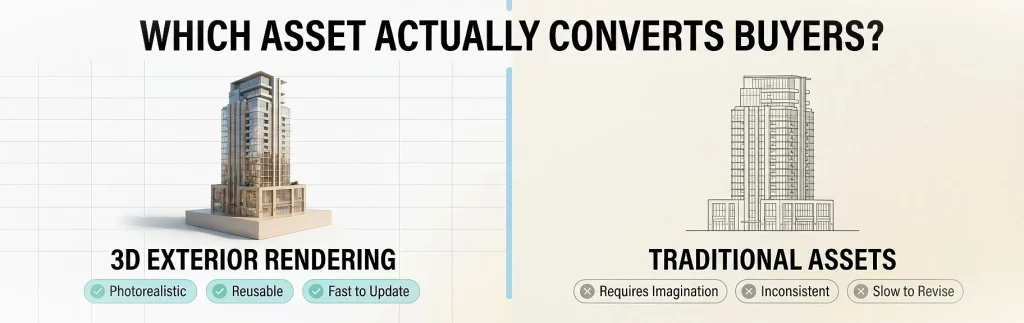
Developers often compare rendering against older approaches before committing budget. Here’s how the two stack up on the factors that matter most in a pre-sales timeline:
| Factor | 3D Exterior Rendering | Traditional Assets (sketches, elevations, photos of similar projects) |
|---|---|---|
| Buyer comprehension | High: photorealistic, lifelike materials and lighting | Low to moderate: requires buyer imagination |
| Available before construction | Yes, from design development drawings onward | Partially: only reference photos of unrelated buildings |
| Consistency across channels | Same asset reused everywhere | Mismatched visuals across print and digital |
| Revision speed | Digital updates as design evolves | Costly or impossible to update quickly |
| Investor/lender confidence | Strong: reads as a finished product | Weaker: reads as a concept only |
Rendering Packages and Turnaround Times for Pre-Sales Campaigns
Budget and scheduling questions come up early in almost every pre-sales conversation. A detailed breakdown of pricing tiers is covered in our 3D exterior rendering cost and price guide, but the table below gives a general sense of what to expect.

| Package | Typical Deliverables | Typical Turnaround | Best Suited For |
|---|---|---|---|
| Starter | 1-2 hero exterior renders | 1-2 weeks | Early feasibility, initial landing page |
| Campaign | 4-6 renders, multiple angles, day/dusk lighting | 2-3 weeks | Full pre-sales launch, paid media set |
| Full Suite | Renders, walkthrough animation, print-ready files | 3-5 weeks | Sales gallery, investor presentations, multi-channel launch |
For teams planning the production sequence in more detail, our 3D exterior rendering workflow resource walks through each production milestone from kickoff to final delivery.
Common Mistakes Developers Make with Pre-Sales Renderings
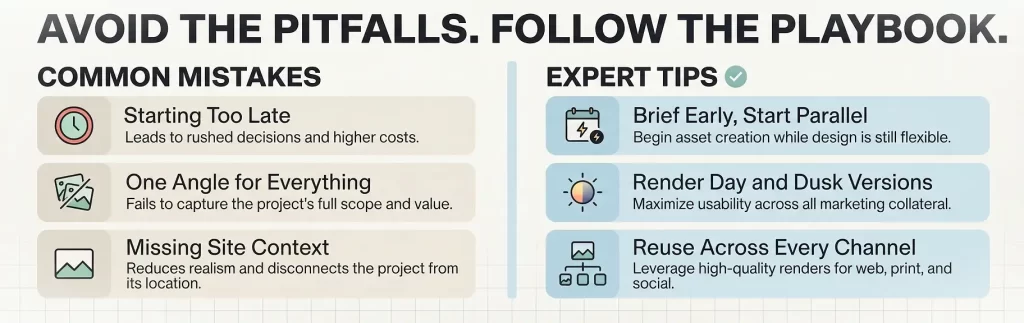
- Starting too late. Waiting until construction drawings are 100% final delays the entire marketing timeline by weeks or months.
- Using a single hero shot everywhere. One angle rarely covers a website hero, a social ad crop, and a print brochure equally well.
- Skipping context and landscaping. Renders without street context or realistic surroundings make buyers underestimate how the finished building will actually feel.
- Ignoring lighting variation. A single lighting condition (always daytime, for instance) undersells a project’s evening presence and curb appeal.
- Not budgeting for revisions. Design changes late in the process are normal; not planning for a revision round creates avoidable delays right before launch.
Expert Tips to Maximize Pre-Sales Rendering ROI
- Lock in the render brief (angles, lighting, deliverable formats) before design development is fully finalized, so production can start in parallel.
- Request both daytime and dusk versions of the hero render; dusk renders consistently perform well in paid social creative.
- Reuse the same render set across the sales gallery, brochure, and digital ads to reinforce brand consistency, a strategy also outlined in our guide to 3D exterior rendering for single-family home builders.
- For multi-unit or rental-focused developments, plan renders that show the building alongside amenity spaces and site context; our piece on 3D exterior rendering for purpose-built rental communities goes deeper on this.
- Treat the rendering vendor as a production partner, not a one-time contractor, so updates during the pre-sales window stay fast and consistent.
Frequently Asked Questions
What is 3D exterior rendering in real estate pre-sales?
3D exterior rendering in real estate pre-sales is the creation of photorealistic digital images of a building’s exterior, produced before construction is complete, so developers can market and sell units off-plan.
How much does a 3D exterior rendering for a pre-sales campaign cost?
Pricing depends on building complexity, the number of angles requested, lighting scenarios, and turnaround time. Our cost and price guide breaks down typical ranges by package type.
How long does it take to get 3D exterior renderings for a pre-sales launch?
Standard turnaround for a pre-sales exterior render set is typically one to three weeks, depending on scene complexity and the number of revision rounds included.
Can 3D exterior renderings be used before construction drawings are finalized?
Yes. Renderings can be produced from schematic or design development drawings, then updated as the design is refined, which is exactly why most pre-sales campaigns start rendering early.
Do 3D exterior renderings actually increase pre-sales conversion rates?
Photorealistic renderings help buyers visualize a finished project with far less guesswork, which commonly shortens the decision cycle compared to floor plans or sketches alone.
Conclusion
3D exterior rendering pre-sales real estate campaigns work because they replace uncertainty with a clear, consistent visual promise, one that can be produced, refined, and reused across every stage of a launch. Developers who plan renders early, budget for revisions, and reuse assets across channels consistently see smoother, faster pre-sales timelines than those relying on sketches or generic reference photos.
If you’re planning a pre-sales launch and need a rendering partner who understands both the creative and the deadline pressure involved, get a quote from The 3D Exterior Rendering Company to start mapping your render package to your campaign timeline.
Start Your Next Project with The 3D Exterior Rendering Company →