Understanding the true 3D exterior rendering cost is one of the first questions architects, developers, and real estate professionals ask before committing to a project. The answer, however, is rarely a single number. Prices vary widely based on quality, complexity, turnaround time, and the type of studio you hire. Whether you are planning a single-family home presentation or a large commercial development, knowing what to expect helps you budget accurately and get the best return on your investment.
This guide breaks down every factor that influences exterior rendering pricing, provides real-world price ranges, and shows you exactly what is included at each quality tier. By the end, you will know precisely what to ask your rendering provider and how to avoid overpaying for results that fall short of expectations.
What is 3D Exterior Rendering?
3D exterior rendering is the process of creating a photorealistic or stylized digital image of a building’s outside appearance before it is built or renovated. Using architectural drawings, design specifications, and site data, a rendering artist builds a three-dimensional model and applies materials, lighting, landscaping, and environmental context to produce a final image that looks like a photograph.
These visuals serve several key purposes:
- Presenting proposals to clients, investors, or planning committees
- Marketing properties off-plan before construction begins
- Identifying design issues before costly construction errors occur
- Creating listing images for real estate sales and marketing campaigns
- Supporting permit and planning applications with professional visuals
According to research by the National Association of Realtors, listings with high-quality visual content consistently attract more views and sell faster than those with standard photography alone. That insight applies equally to pre-construction visuals: a compelling exterior render can be the difference between a project that generates interest and one that stalls.
3D Exterior Rendering Cost: A Breakdown by Quality Tier
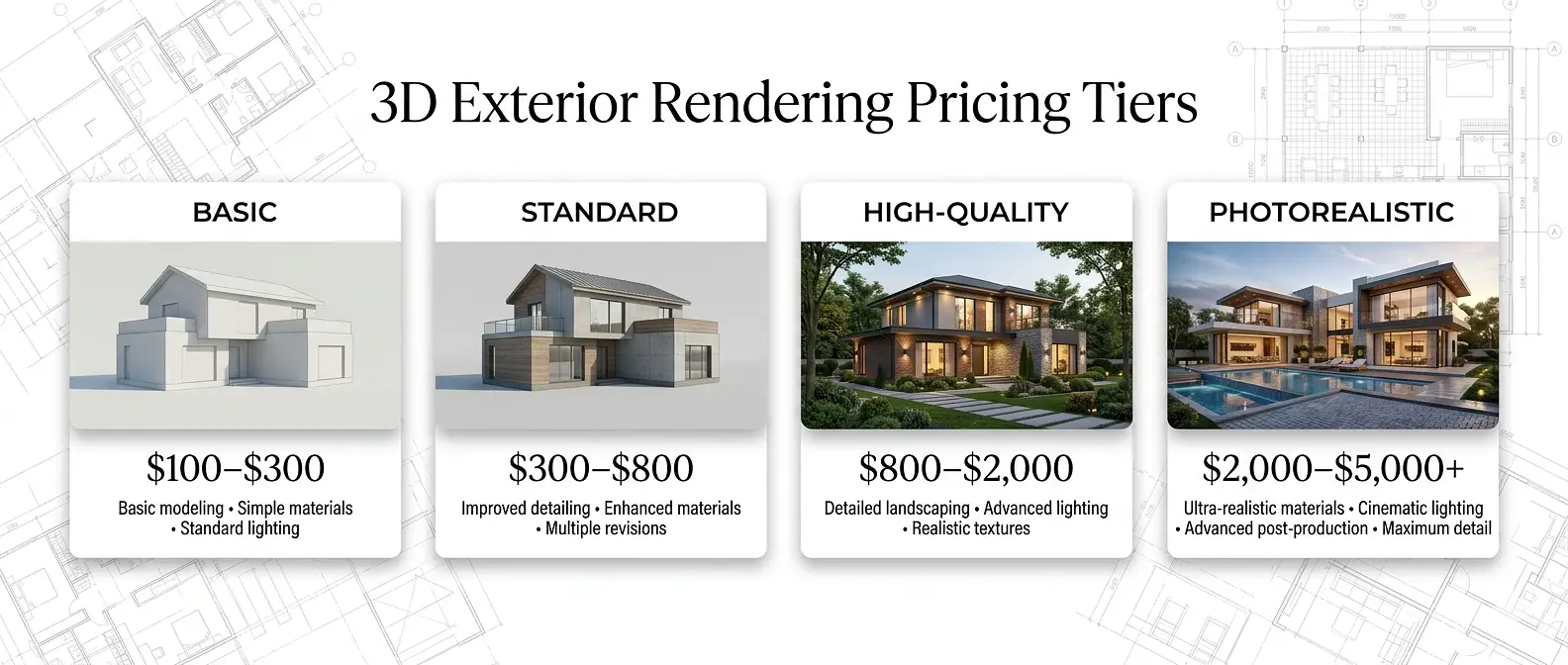
The most straightforward way to understand exterior rendering pricing is through quality tiers. Each tier reflects the level of detail, realism, and production effort involved. Here is what the market currently looks like in 2025:
| Quality Tier | Price Range (Per View) |
Best For | Typical Turnaround |
|---|---|---|---|
| Basic / Schematic | $100 – $300 | Early design concepts, internal reviews | 1–2 days |
| Standard Residential | $300 – $700 | Single-family homes, small multi-family | 3–5 days |
| High-Quality Residential | $700 – $1,200 | Luxury homes, townhouses, real estate marketing | 5–7 days |
| Commercial / Mixed-Use | $1,000 – $2,500 | Retail, office, hospitality, mixed-use developments | 7–14 days |
| Ultra-Photorealistic / Premium | $2,000 – $5,000+ | High-end luxury, developer marketing suites | 10–21 days |
Quick Answer: The average 3D exterior rendering cost for a standard residential project sits between $300 and $1,200 per image. Commercial projects and premium photorealistic work typically start at $1,000 and can exceed $5,000 for complex, large-scale developments.
Key Factors That Influence 3D Exterior Rendering Pricing
Price tiers give you a starting point, but the actual 3D exterior rendering cost for your specific project depends on several overlapping variables. Understanding each factor helps you control costs without compromising quality.
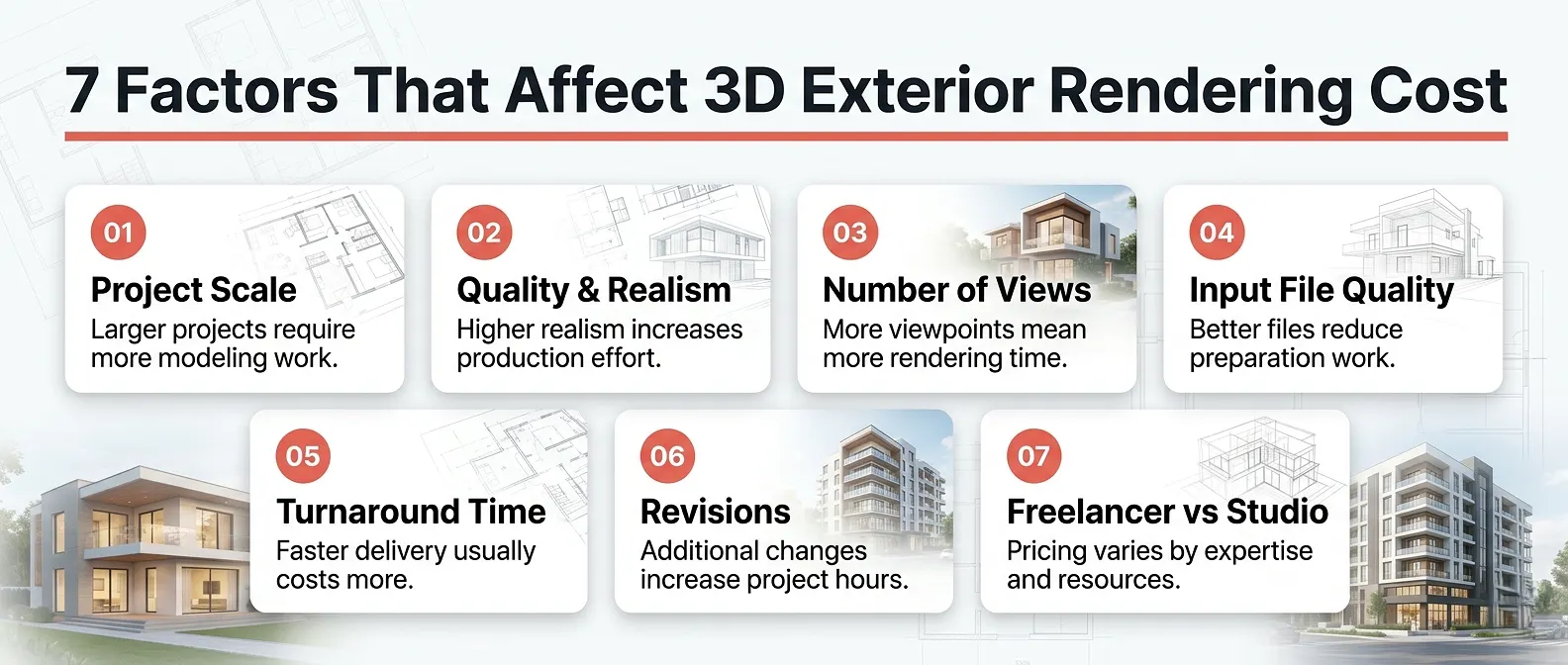
1. Project Type and Scale
A single-family residential home requires far less modeling time than a 30-story mixed-use tower. Larger footprints, more complex geometry, and higher numbers of unique facades directly increase the time and skill required to produce the render. As a general rule:
- Residential homes: Lower complexity, lower cost
- Townhouses and row houses: Moderate complexity
- Multi-family and apartment buildings: Higher complexity
- Commercial, retail, and hospitality: Highest complexity and cost
2. Level of Detail and Photorealism
The degree of realism in the final image is one of the biggest cost drivers. Adding high-resolution material textures, realistic lighting simulations, detailed landscaping with individual plant species, people, vehicles, and atmospheric effects all require significantly more rendering and post-production time. Each additional layer of realism typically adds to the overall cost.
3. Number of Views and Camera Angles
Most studios price each view individually. A standard exterior package might include one hero view, but clients often request additional angles: a street view, a rear elevation, a dusk perspective, and an aerial shot. Each additional view adds to the total cost, though many studios offer volume discounts when multiple views are ordered together.
4. Input Files and Drawing Quality
The quality and completeness of your input files directly affect the price. If you provide detailed CAD drawings, material schedules, and site plans, the modeling process is straightforward. However, if the studio must interpret vague sketches, make design decisions, or reverse-engineer dimensions, expect additional fees for that extra modeling effort.
5. Turnaround Time
Rush delivery almost always costs more. Standard turnaround at most reputable studios runs between 3 and 7 business days. Requesting delivery within 24–48 hours typically attracts a rush premium of 25–50% above the base price. Planning ahead is one of the simplest ways to keep your exterior rendering costs under control.
6. Revisions and Change Requests
Most studios include one or two rounds of minor revisions in their base price. Structural design changes, new material selections, or significant composition alterations after work begins typically incur additional fees. Clear briefs and detailed input files at the start prevent costly revisions later.
7. Freelancer vs. Rendering Studio
Freelance rendering artists generally charge lower rates than dedicated studios, with prices often 20–40% below studio pricing. However, studios offer advantages that often justify the difference: project management, quality control, consistent output across large projects, and reliable communication. For high-stakes marketing materials, a reputable studio is usually the safer choice.
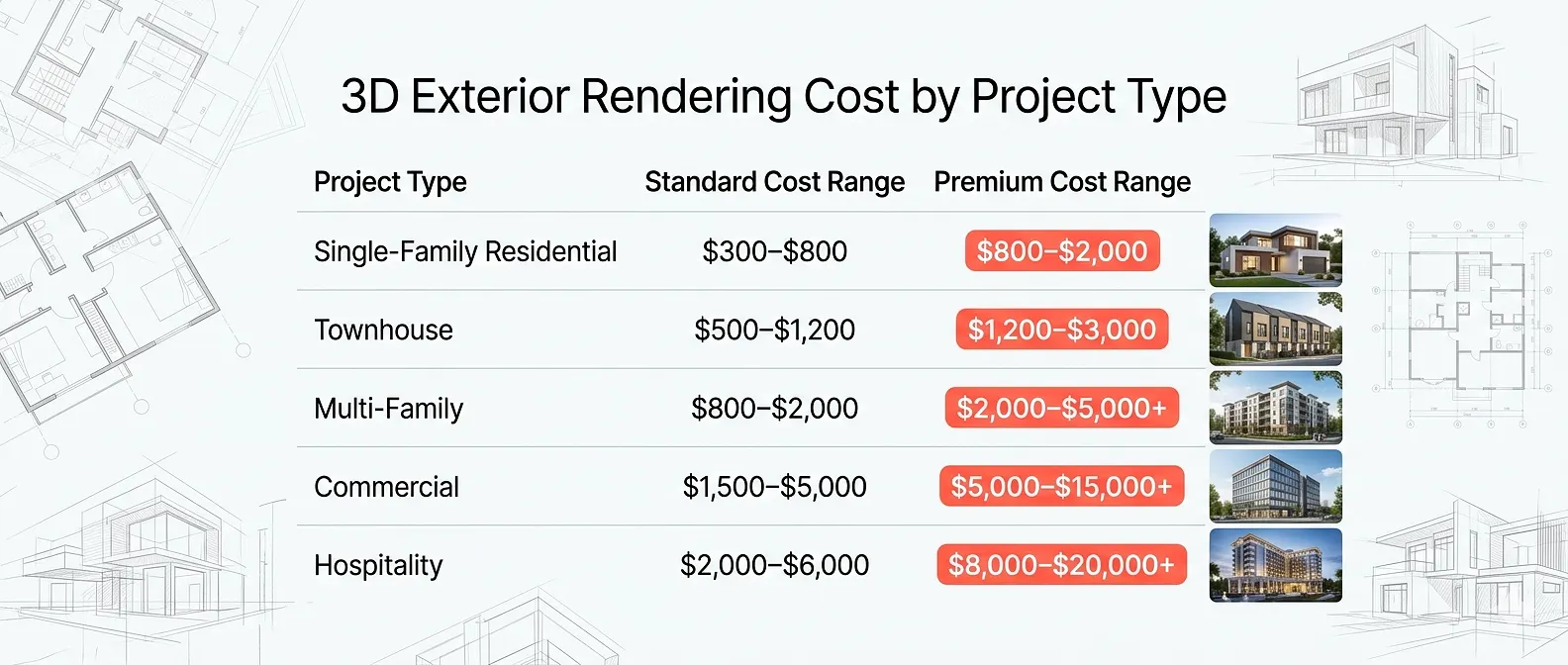
3D Exterior Rendering Cost by Project Type
Different project categories carry distinct pricing expectations. Here is a closer look at what you can realistically expect to pay by type:
Residential Single-Family Homes
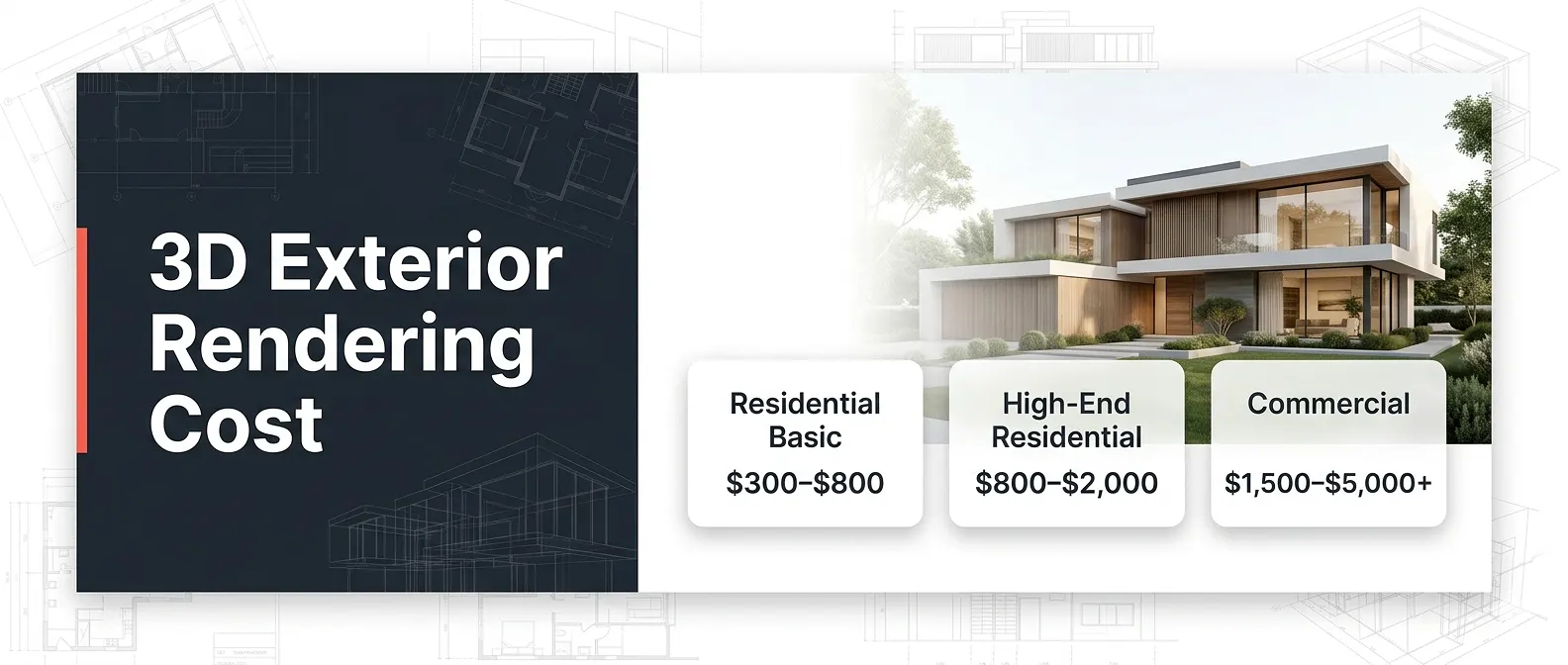
This is the most common category for exterior renders, and pricing reflects that scale. A standard photorealistic view of a single-family home typically costs between $300 and $800. Luxury custom homes with complex architectural features, extensive landscaping, and high-end material specifications can reach $1,200 to $2,000 per view.
Townhouses and Semi-Detached Properties
Townhouse blocks require modeling multiple units within the same scene. Pricing typically falls between $500 and $1,200 per view, depending on how many units are in the block and the level of streetscape detail required.
Multi-Family and Apartment Buildings
Apartment complexes and multi-family developments demand more detailed modeling and often require several different camera angles for marketing purposes. Expect pricing between $800 and $2,500 per view, with full marketing packages that include multiple angles and dusk views priced as complete packages ranging from $3,000 to $8,000.
Commercial and Mixed-Use Developments
Commercial projects involve the most complex modeling: large-scale facades, signage, pedestrian environments, and detailed contextual surroundings. Pricing for commercial exterior renders typically starts at $1,500 and can exceed $5,000 for large-scale, photorealistic work intended for investor presentations or planning applications.
Hospitality and Luxury Resort
Hotel and resort projects demand ultra-realistic finishes, elaborate landscape design, atmospheric lighting, and people animation. These are among the most expensive exterior rendering categories, with per-view pricing ranging from $2,000 to $8,000+ for premium output.
| Project Type | Standard Cost (Per View) | Premium / Photorealistic |
|---|---|---|
| Single-Family Residential | $300 – $800 | $1,200 – $2,000 |
| Townhouse / Row House | $500 – $1,200 | $1,500 – $2,500 |
| Multi-Family / Apartments | $800 – $2,500 | $3,000 – $8,000 (package) |
| Commercial / Mixed-Use | $1,500 – $3,000 | $3,500 – $6,000+ |
| Hospitality / Luxury Resort | $2,000 – $4,000 | $5,000 – $10,000+ |
What is Included at Each 3D Exterior Rendering Price Point?
Knowing the price is only useful if you understand what you are actually getting for that investment. Here is a breakdown of what leading studios typically deliver at each price tier:
$100 – $300: Basic / Conceptual Renders
- Simple 3D model from basic drawings
- Flat or semi-realistic materials
- Basic sky and minimal landscaping
- Suitable for early-stage design reviews only
- Limited post-production and color correction
$300 – $800: Standard Residential Renders
- Detailed 3D model with accurate architectural features
- Realistic material textures (brick, timber, render, glass)
- Soft natural lighting with sky HDRI
- Basic landscaping: lawn, hedges, pathway
- One to two rounds of minor revisions included
- Final output at 3,000px width or higher
$800 – $2,000: High-Quality Residential and Lower-End Commercial
- Highly detailed architectural modeling
- Premium material libraries and custom texture mapping
- Advanced lighting: golden hour, overcast, dusk options
- Detailed landscaping: species-specific plants, mature trees
- Entourage elements: people, vehicles, context buildings
- Professional post-production: atmosphere, depth of field, color grading
- Multiple revision rounds
$2,000 – $5,000+: Premium and Ultra-Photorealistic Renders
- Studio-grade photorealistic output indistinguishable from photography
- Bespoke material creation for unusual or custom finishes
- Complex site context with neighboring buildings, roads, and urban environment
- Multiple lighting scenarios included (day, dusk, night)
- Drone/aerial camera angles
- Animation stills or short fly-through sequences upon request
- Priority production and dedicated project manager
How to Reduce Your 3D Exterior Rendering Cost Without Losing Quality
Getting high-quality exterior renders does not necessarily mean spending the maximum. With the right approach, you can reduce costs while still receiving polished, professional results.
Provide Complete, High-Quality Input Files
The single most effective cost-reduction strategy is providing thorough, accurate documentation at the outset. This includes fully detailed CAD files, elevation drawings, a material schedule with specific product references, and a clear site plan. The clearer your brief, the less time your studio spends interpreting missing information; and that time savings translates directly into lower costs and fewer revision rounds.
Order Multiple Views Together
When a studio has already built the 3D model for one view, adding additional camera angles costs significantly less than commissioning each view individually. Most studios offer discounted rates for multi-view packages. If you know you will need three or four views, order them together rather than adding them one at a time.
Plan Your Deadline Realistically
Avoid rush fees by planning your project timeline in advance. Build at least 7–10 business days into your schedule for standard residential work, and 14–21 days for commercial projects. Rush delivery at many studios adds 25–50% to the base price; planning ahead eliminates that premium entirely.
Use a Staged Quality Approach
For early-stage design work, commission standard-quality renders to confirm the design direction. Once the design is locked, invest in premium photorealistic output for the final marketing phase. This staged approach avoids spending premium budget on renders that may be revised significantly.
Choose the Right Studio for Your Project Scale
A large studio with an extensive client list may not offer the most competitive pricing for a small residential project. Equally, a freelancer working alone may not have the capacity or quality controls needed for a major commercial development. Matching your studio choice to your project scale is a practical way to get the best value.
Common Mistakes When Budgeting for 3D Exterior Rendering
Even experienced developers and architects sometimes make avoidable mistakes when commissioning exterior renders. Being aware of these pitfalls can save both time and money.
Choosing the Cheapest Option Without Reviewing Portfolios
The lowest quote is not always the best value. Low-cost providers often use generic material libraries, basic lighting, and minimal post-production, producing results that look noticeably artificial. Always review a studio’s actual portfolio for projects similar to yours before committing. According to Autodesk’s architecture and construction research, the quality of design visualization directly impacts client conversion rates and project approval success.
Underestimating the Number of Views Needed
Many clients start by ordering one hero view, then realize they need additional angles for marketing, planning applications, and investor presentations. Adding views after the initial project is completed typically costs more than ordering them all at once. Think through all the ways you will use the imagery before you brief your studio.
Not Providing a Detailed Brief
Vague briefs lead to misaligned expectations, more revision rounds, and higher final costs. A strong brief should include the architectural drawings, preferred material finishes, time-of-day preferences for lighting, the intended use of the renders, and any reference images that reflect the visual style you are aiming for.
Ignoring Licensing and Usage Rights
Always clarify who owns the rendered images and what you are permitted to do with them. Some studios retain intellectual property rights and license use of the renders to the client. If you intend to use images for commercial advertising, printed marketing, or online campaigns, confirm that your licensing agreement covers those uses.
Leaving Insufficient Time for Revisions
Even the most detailed brief may require one or two rounds of revisions. Build revision time into your project schedule. A first draft delivered on the day you need final images leaves no room to refine the output.
Expert Tips for Getting the Best Value from Your 3D Exterior Rendering Investment
Industry professionals who commission exterior renders regularly develop a set of best practices that consistently lead to better outcomes. Here are the most valuable insights:
- Specify your output resolution early. Marketing campaigns, billboards, and print materials require much higher resolution files than website use. Confirm the output size before work begins to avoid expensive re-renders later.
- Request a test render before full production. For large or complex projects, many studios offer a low-resolution test render before proceeding to full production. This allows you to confirm the camera angle, composition, and material direction before significant time is invested.
- Agree on a revision scope in writing. Clearly define what constitutes a minor revision (adjusting a material or a plant) versus a major revision (changing the building geometry or camera angle). Having this agreed in writing prevents disputes about additional charges.
- Reference images are invaluable. The more visual references you provide, the more accurately the studio can match your intended aesthetic. Share inspiration images from platforms like ArchDaily to help your rendering team understand the mood, material palette, and level of realism you are targeting.
- Plan for multiple uses. A photorealistic exterior render can serve multiple purposes: website banner, brochure cover, social media content, investor deck, and planning submission. Commissioning the highest quality version once is almost always more cost-effective than producing multiple different versions for different uses.
- Ask about package pricing. Most studios offer discounted packages when combining exterior renders with interior renders, floor plans, or aerial views. Bundling your visualization needs in a single project typically reduces the per-asset cost by 15–30%.
How to Choose the Right Studio for Your 3D Exterior Rendering Project
With hundreds of studios and freelancers competing for your business, selecting the right partner is as important as setting the right budget. Here is a step-by-step process for making a confident choice:
- Define your project requirements precisely before approaching studios. Know your project type, the number of views needed, your intended use cases, and your target delivery date.
- Review portfolios critically. Look for examples of projects similar in scale and style to yours. A studio specializing in residential homes may not be the best choice for a large commercial development, and vice versa.
- Request itemized quotes. Ask each studio to break down their pricing so you can compare like for like. A quote that includes revisions, licensing, and high-resolution output is more valuable than a lower headline number with additional charges hidden in the fine print.
- Check communication responsiveness. A studio that responds slowly during the sales process often responds slowly during production too. Fast, clear communication is a sign of a well-managed studio.
- Confirm your file delivery formats. Ensure the studio delivers source files, high-resolution TIF or PNG masters, and any agreed variations in formats compatible with your workflow.
- Look for industry recognition and client references. Studios that have worked with recognized developers, architectural firms, or real estate agencies bring a level of credibility and accountability that reduces your risk.
Get an Accurate Quote for Your Project Today
The Real Estate Rendering Company delivers photorealistic exterior renders for residential, commercial, and mixed-use developments. Fast turnarounds. Competitive pricing. Uncompromising quality.
Request a Free QuoteExterior Rendering vs. Other Architectural Visualization Types: A Cost Comparison
Exterior renders are just one part of the broader architectural visualization toolkit. Understanding how they compare in cost and purpose to other visualization types helps you allocate your budget effectively.
| Visualization Type | Typical Cost Range | Best Application |
|---|---|---|
| 3D Exterior Rendering (Still) | $300 – $5,000+ per view | Marketing, planning, investor presentations |
| 3D Interior Rendering (Still) | $200 – $3,000+ per view | Show homes, developer marketing suites |
| 3D Floor Plan | $100 – $400 per floor | Sales listings, brochures, planning applications |
| Architectural Animation (Fly-through) | $2,000 – $15,000+ | Developer launches, investor presentations |
| Virtual Tour (360°) | $1,500 – $8,000 | Off-plan property sales, show home replacement |
| Physical Scale Model | $5,000 – $50,000+ | Major development exhibitions |
For most residential and commercial projects, 3D exterior rendering offers the strongest combination of visual impact, cost efficiency, and versatility. A single high-quality exterior render can be used across print, digital, social media, and planning submissions; making it one of the most cost-effective marketing tools in a developer’s toolkit.
Conclusion: Understanding 3D Exterior Rendering Cost and Making the Right Choice
The 3D exterior rendering cost for your project ultimately comes down to a balance between your budget, your timeline, and the quality of output you need. Standard residential renders can be produced professionally for $300 to $800 per view, while complex commercial or ultra-photorealistic premium work often exceeds $2,000 per view. Understanding what sits behind each price point helps you make confident commissioning decisions and get genuine value from your investment.
The most important steps are to provide detailed input files, plan your deadline realistically, brief your studio clearly, and choose a provider whose portfolio demonstrates experience with projects similar to yours. When all these elements align, exterior 3D rendering delivers an exceptional return: it builds buyer confidence, accelerates off-plan sales, supports planning approval, and elevates your brand in a competitive market.
According to the American Institute of Architects, visualization quality has become one of the most significant differentiators in architectural project delivery and client satisfaction. Investing in the right level of exterior rendering quality is not simply an aesthetic decision; it is a business decision with measurable impact on your project’s commercial success.
Ready to Get Started?
Contact The Real Estate Rendering Company for a transparent, itemized quote on your exterior rendering project. Residential, commercial, and mixed-use projects welcome.
Get Your Free QuoteFrequently Asked Questions About 3D Exterior Rendering Cost
How much does a 3D exterior rendering cost on average?
The average 3D exterior rendering cost ranges from $200 to $2,000+ per image, depending on quality tier, project complexity, number of views, and turnaround time. Basic residential renders start around $200 to $500, while high-end photorealistic renders for luxury or commercial projects can exceed $2,000 per view.
What factors affect 3D exterior rendering pricing?
Key factors include project complexity (residential vs. commercial), quality level (standard vs. photorealistic), number of views requested, turnaround time, level of detail in landscaping and surroundings, and the experience of the rendering studio. Providing complete, detailed input files is one of the most effective ways to keep costs down.
Is it cheaper to use a freelancer or a rendering studio?
Freelancers typically charge 20 to 40% less per image than dedicated studios. However, rendering studios offer greater quality consistency, faster turnaround, and more reliable project management. For high-stakes marketing materials or large-scale developments, a studio is often the better investment overall.
How long does a 3D exterior rendering take?
Standard delivery is typically 3 to 7 business days per image for residential projects. Commercial and complex projects may require 7 to 14 business days. Rush turnarounds of 24 to 48 hours are available at premium rates, usually adding 25 to 50% to the base price.
Can I get 3D exterior renderings for a small residential project?
Yes. Many rendering studios offer competitively priced packages for single-family homes, townhouses, and small multi-family projects. Standard quality exterior renders for smaller residential projects start at $300 to $500 per view and include professional materials, lighting, and basic landscaping.
Do rendering studios include revisions in their pricing?
Most reputable studios include one to two rounds of minor revisions in their base pricing. Major revisions, such as geometry changes or significant material overhauls, are typically charged at an additional hourly or per-revision rate. Always confirm the revision policy in writing before work begins.
What is the difference between a standard and a photorealistic exterior rendering?
A standard exterior rendering uses solid material textures, basic lighting, and generic landscaping elements. A photorealistic rendering applies physically based rendering (PBR) materials, high-dynamic-range (HDR) lighting, detailed entourage, atmospheric effects, and extensive post-production to produce an image that is effectively indistinguishable from a photograph. The quality difference is significant, and so is the corresponding difference in cost.
Article produced by The Real Estate Rendering Company. For high-quality exterior and interior architectural visualization services, visit therealestaterenderingcompany.com.
One thought on “How Much Does 3D Exterior Rendering Cost? Price Guide and Complete Breakdown”